A construction environmental management plan (CEMP) is a mandatory, site-specific document that every Victorian construction project must have approved before work begins. It identifies environmental risks on and around the site, from noise and dust to water contamination and habitat disruption, and sets out the controls that will keep those risks in check throughout the build. Without an approved CEMP, councils will not issue the green light to commence works, and the consequences of proceeding without one range from stop-work orders to prosecution.
Key environmental risks a CEMP must address include:
- Noise and vibration from plant, machinery, and demolition activities
- Dust and air quality impacts on neighboring properties and sensitive receivers
- Stormwater and water quality protection, including sediment runoff and chemical spills
- Construction waste management, covering both general waste and liquid waste disposal
- Flora and fauna protection, particularly where native vegetation or waterways are present
- Site contamination risks from existing soil conditions or construction materials
Victorian CEMPs draw on the General Environmental Duty established under the Environment Protection Act, which requires all parties to understand, eliminate, or minimize environmental risks from their activities. EPA Victoria, Melbourne Water, and the Department of Energy, Environment and Climate Action (DEECA) may all have input into a CEMP, but municipal council approval remains mandatory for every project, regardless of what other agencies require.
What are the regulatory requirements for CEMP approval in Victoria?
Victorian councils treat CEMP approval as a condition precedent to construction, not an administrative formality. The City of Whittlesea requires all projects to submit through its Development Engineering online portal, and officers conduct regular site inspections to verify compliance against the approved document.
Mitchell Shire Council operates on a 5-business-day review window once a complete submission is received, but the council strongly recommends lodging well before the 28-day mark to allow time for feedback, revisions, and any pre-commencement requests. Submitting late compresses that buffer and risks delaying your construction start date.
Key regulatory requirements across Victorian councils typically include:
- Approved engineering and civil plans must be current and reflected in the CEMP at the time of submission
- Traffic Management Plan (TMP) integration is required, as councils assess construction traffic impacts alongside environmental controls
- Risk Assessment Checklist and site-specific environmental protection measure designs (Site Plan 1 and Site Plan 2) must accompany the submission
- Separate approvals from EPA Victoria or Melbourne Water must be obtained independently, though council approval remains a separate, mandatory step
- Amendment process: if council raises questions or requests changes, all issues must be addressed and the plan updated before re-submission
- Arborist assessments or vegetation removal permits are required where trees or native vegetation are affected
The CEMP must align with the council’s own Guidelines and Standards Manual, which sets out acceptable standard measures for each environmental issue. Submitting a plan that references outdated engineering drawings or ignores the manual’s standards is one of the fastest routes to rejection.
What does an effective CEMP actually contain?
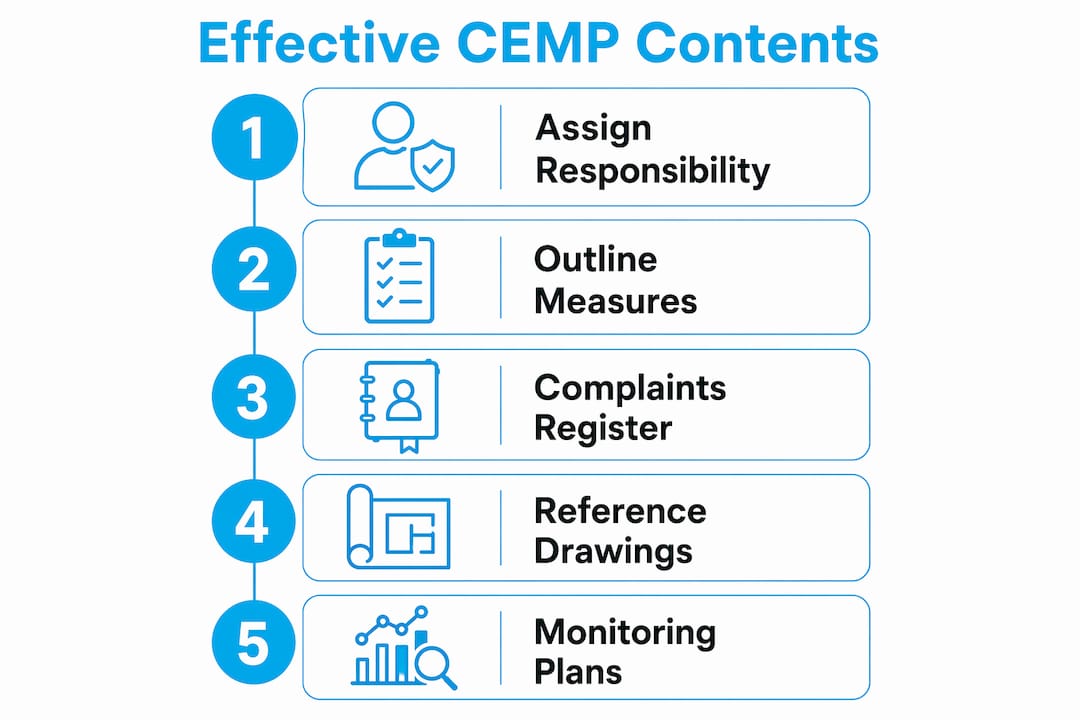
A well-structured CEMP is organized around five core content areas: environmental risk identification, mitigation strategies, monitoring and reporting protocols, defined roles and responsibilities, and stakeholder communication. Each section must be specific to the site, not lifted from a previously approved plan.
Common environmental issues addressed in the document include:
- Noise and vibration controls: standard construction hours in Victoria run Monday to Saturday (excluding public holidays) between 7 AM and 7 PM; the CEMP must demonstrate how noise will be managed within and outside those hours
- Dust suppression: methods such as water spraying, wheel wash stations, and covering stockpiles
- Sediment and erosion controls: silt fences, sediment basins, and stabilized site entries to protect drainage infrastructure and receiving waters
- Waste management: segregation of general waste, liquid waste, and hazardous materials, with licensed disposal pathways documented
- Water quality protection: preventing pollutants, concrete washout, and hard waste residues from entering the stormwater system
- Flora and fauna protection: exclusion fencing, pre-clearance surveys, and vegetation removal protocols where applicable
- Emergency response procedures: spill response, incident notification, and corrective action steps
The CEMP must also name the person or persons responsible for implementing each measure, and include a complaints register and communication plan for affected neighbors and stakeholders. Integration with the site’s safety and quality management plans keeps all site personnel working from a consistent set of protocols, reducing the risk of conflicting instructions on the ground.
Pro Tip: Reference your CEMP directly to sheet numbers and revision dates on your engineering drawings. Councils check for this alignment, and a mismatch between your CEMP controls and the approved civil plans is a common reason for rejection.
How do you prepare, implement, and maintain a compliant CEMP?
Start the CEMP framework before final planning approval is granted. Preparing early gives you a clearer picture of your environmental commitments and makes the approval process faster once planning conditions are issued. Many Victorian construction projects require a CEMP as a condition of planning permission itself, so having a draft ready accelerates that conversation with the council.
Copying a previously approved CEMP is one of the most common mistakes project managers make, and councils flag it quickly. Every plan must be built from a site-specific risk assessment tied to the actual engineering plans for that project. Generic templates produce generic controls that rarely match the real hazards on the ground.
Practical steps for preparing and maintaining a compliant plan:
- Conduct a site-specific environmental risk assessment before drafting any controls, using the actual topography, drainage patterns, and neighboring land uses
- Engage a chartered ecologist or environmental consultant for complex sites involving waterways, native vegetation, or contaminated land, where regulatory requirements go beyond standard council checklists
- Train all site personnel in their responsibilities under the approved CEMP before works begin; staff competency in environmental awareness is a documented requirement, not optional
- Establish a monitoring schedule with defined inspection frequencies, responsible officers, and recording formats
- Keep an audit trail: inspection records, non-conformance reports, and corrective actions must be documented and available for council officers during site visits
- Update the CEMP when site conditions change, including scope changes, new subcontractors, or unexpected contamination finds; submit amendments to council promptly
Methods like non-destructive digging support CEMP compliance directly by eliminating the risk of underground utility strikes and minimizing soil disturbance, which reduces both contamination risk and the volume of spoil requiring management. Applying a Plan-Do-Check-Act approach, consistent with ISO 14001 principles, keeps the CEMP a living document rather than a filing cabinet artifact.
What are the legal obligations and penalties for CEMP non-compliance in Victoria?
The principal contractor carries legal responsibility for implementing the approved CEMP on site. This is not a delegable obligation in practice. If a subcontractor causes a pollution incident and the CEMP controls were not in place or enforced, the principal contractor faces the consequences.
Victorian councils hold enforcement powers that include issuing directions to comply, issuing infringement notices, and prosecuting parties where non-compliance is found. Officers conduct unannounced inspections and compare site conditions directly against the approved CEMP. Discrepancies between what the plan says and what is happening on the ground are treated as breaches.
Key compliance obligations to manage:
- Accuracy of the submitted CEMP: the plan must reflect the most current approved engineering and planning documents at the time of submission; submitting a plan based on superseded drawings creates an immediate compliance gap
- Record-keeping: inspection logs, complaints registers, and corrective action records must be maintained throughout the project and made available to council on request
- Timely amendments: when project scope changes, the CEMP must be updated and resubmitted; operating under an outdated plan is treated the same as operating without one
- Coordination with EPA Victoria: where EPA conditions apply, the CEMP must demonstrate alignment with those conditions alongside council requirements; municipal approval does not substitute for EPA compliance, and vice versa
- Stormwater protection: annual stormwater pit cleaning and ongoing drainage maintenance are part of the environmental duty that extends beyond the construction phase itself
The General Environmental Duty under the Environment Protection Act means that even where a specific CEMP condition does not exist, parties must still take reasonable steps to prevent environmental harm. A CEMP that is thorough, site-specific, and actively maintained is the clearest evidence that this duty is being met.
Key Takeaways
A compliant CEMP, prepared early and tailored to the specific site, is the single most effective tool for keeping a Victorian construction project on schedule and out of legal trouble.
| Point | Details |
|---|---|
| Council approval is mandatory | Every Victorian construction project needs an approved CEMP before works begin, regardless of other agency approvals. |
| Lodge early, allow 28 days | Submitting with a 28-day buffer before your planned start date reduces the risk of delays from council feedback cycles. |
| Never copy a previous CEMP | Plans must be built from site-specific risk assessments tied to current engineering drawings; generic plans are routinely rejected. |
| Train all site personnel | Staff competency in CEMP protocols is a documented requirement; untrained crews create compliance gaps that councils act on. |
| Update the plan when scope changes | An outdated CEMP carries the same legal exposure as having no plan; submit amendments to council promptly when conditions change. |
Pressureworks supports Victorian construction teams with hydro excavation and NDD services that align directly with CEMP environmental controls, minimizing soil disturbance, protecting underground utilities, and reducing contamination risk on site. If your project requires compliant, damage-free excavation that holds up to council scrutiny, contact Pressureworks to discuss how their EPA-licensed crews can support your environmental management obligations.