

When excavation work qualifies as High Risk Construction Work (HRCW) in Victoria, you need a documented excavation risk assessment and a Safe Work Method Statement (SWMS) before anyone enters the ground. That is the legal baseline under WorkSafe Victoria and Safe Work Australia obligations, and it is the starting point for every decision that follows on site.
WorkSafe Victoria’s compliance code requires that a SWMS identify hazards, state controls, and remain accessible to workers at all times. The Safe Work Australia code of practice mandates that controls follow the Hierarchy of Control, from elimination at the top through to PPE as the last resort. Together, these two instruments define what a compliant excavation safety analysis looks like in Victoria.
Five immediate on-site actions before any digging starts:
- Pause and confirm HRCW status. Any excavation exceeding 1.5 m depth, or where there is a risk of ground collapse, triggers HRCW and requires a SWMS.
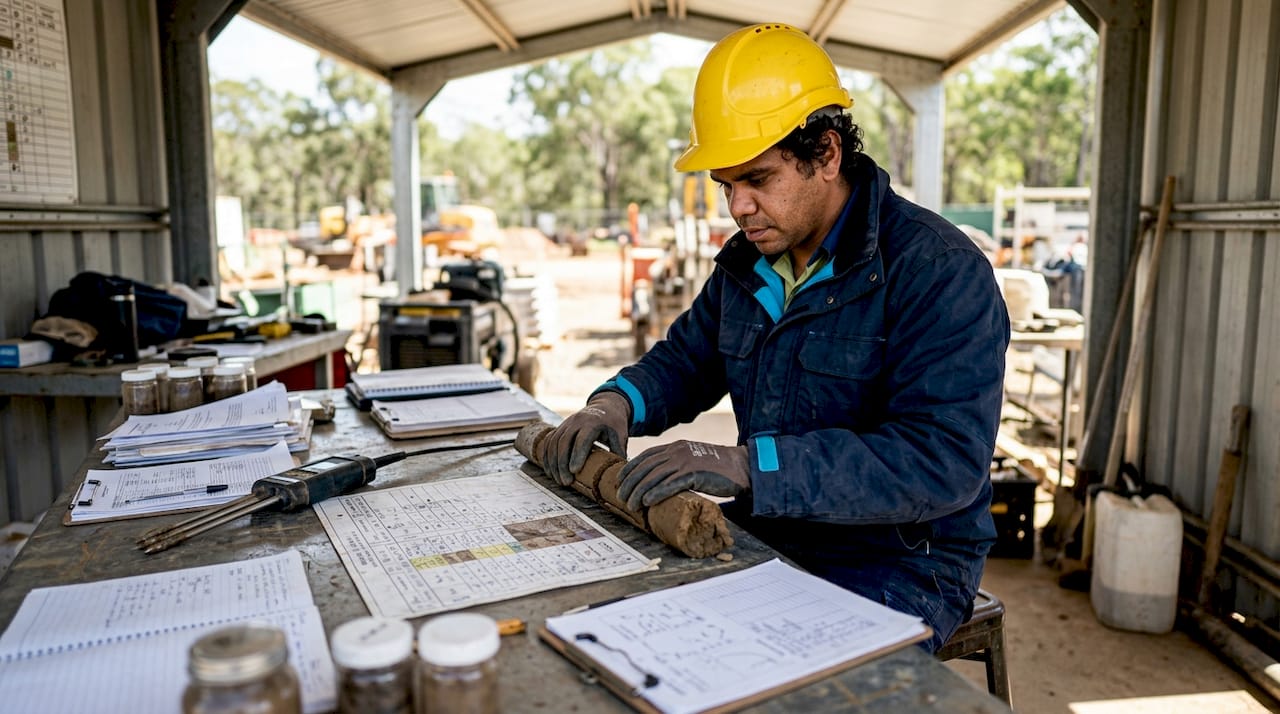
- Engage a competent person. A suitably qualified person, often a geotechnical engineer, must assess ground conditions when soils are uncertain, trenches are deep, or adjacent structures are at risk.
- Locate and verify underground services. Obtain Dial Before You Dig (DBYD) plans, then physically verify service locations using non-destructive digging (NDD) or hand excavation within 1 m of marked services.
- Set and document controls. Apply the Hierarchy of Control and record every control measure in the risk assessment and SWMS before work begins.
- Confirm the SWMS is signed and on site. Workers must have read and signed the SWMS; the document must be physically accessible during the work.
Pro Tip: Where ground conditions are uncertain, a geotechnical investigation and written report are not optional extras. They are the evidence base that makes your support system design defensible under WorkSafe Victoria scrutiny.
Table of Contents
- Your printable excavation risk checklist for site use
- When do you need a formal risk assessment, and who must be involved?
- What hazards must your excavation risk evaluation examine?
- How to rate risk and decide when to escalate
- What control measures and excavation methods should you use?
- How the risk assessment feeds your SWMS and documentation
- Inspection schedule, monitoring, and emergency rescue planning
- When should you choose non-destructive (hydro) excavation?
- Key Takeaways
- What the standard guidance misses about excavation risk in Victoria
- Pressureworks: NDD and hydro excavation services for compliant excavation in Victoria
- Authoritative sources and templates to support your compliance
Your printable excavation risk checklist for site use
Use this checklist at mobilization and at the start of each shift. Copy it to a clipboard, phone, or site tablet. Mark each item Yes, No, or N/A, and add brief notes where controls are conditional.
Pre-work and mobilization checks:
- HRCW trigger confirmed (depth >1.5 m, collapse risk, or other HRCW criteria)? Yes / No / N/A
- SWMS prepared, reviewed, and signed by all workers before entry? Yes / No / N/A
- Dial Before You Dig plans obtained and current? Yes / No / N/A
- Underground services physically verified (NDD or hand dig within 1 m of marked services)? Yes / No / N/A
- Geotechnical report obtained where ground is uncertain or trench is deep? Yes / No / N/A
- Spoil placed at least 600 mm from the excavation edge? Yes / No / N/A
- Shoring, trench box, or battering design confirmed and installed before entry? Yes / No / N/A
- Safe access and egress (ladder or ramp) within 7.6 m of any worker in the trench? Yes / No / N/A
- Exclusion zone established and signed? Yes / No / N/A
- Atmospheric testing completed where hazardous atmosphere is possible? Yes / No / N/A
- Competent person inspection completed and recorded? Yes / No / N/A
- Emergency rescue plan and equipment confirmed on site? Yes / No / N/A
Daily shift checks:
- Competent person pre-shift inspection completed and documented? Yes / No / N/A
- Ground conditions unchanged since last inspection (no cracking, movement, or water ingress)? Yes / No / N/A
- Spoil and plant positions checked (no surcharge loading on trench edge)? Yes / No / N/A
- Shoring or trench box integrity confirmed? Yes / No / N/A
- Egress ladders in place and unobstructed? Yes / No / N/A
- Weather event or vibration since last inspection? If yes, re-inspect before re-entry. Yes / No / N/A
Pro Tip: Version-control your checklist. Each revision should carry a date, the name of the competent person, and a reference to the current SWMS version number and any attached geotechnical report. Attach completed checklists to the site file as inspection records.
When do you need a formal risk assessment, and who must be involved?
Timing across the project lifecycle
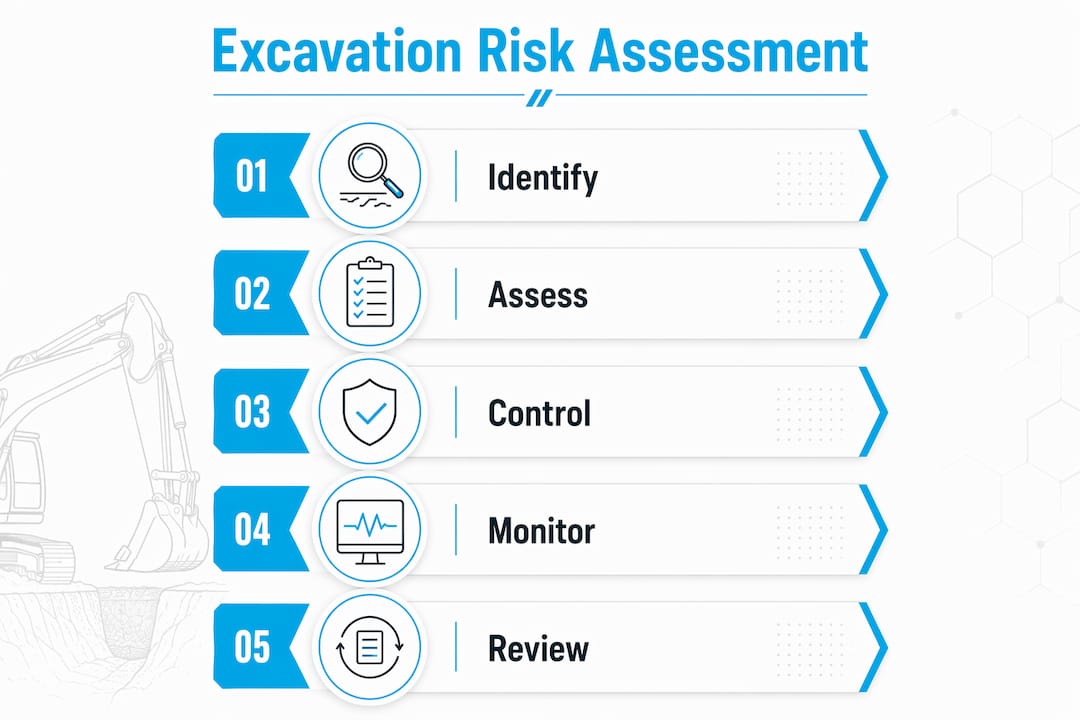
A digging safety assessment should begin at the planning and design stage, not at mobilization. Early assessment lets designers eliminate hazards before they become field problems. That said, WorkSafe Victoria’s code acknowledges that a formal written risk assessment may be unnecessary when hazards and controls are already well understood. In practice, experienced site teams treat formal documentation as mandatory regardless, because a written RA protects duty holders and clarifies controls when conditions change unexpectedly.
Formal assessment is always required when:
- The work is HRCW (depth >1.5 m, or risk of ground collapse at any depth).
- Ground conditions are uncertain, variable, or previously disturbed.
- Adjacent structures, utilities, or watercourses are within the zone of influence.
- Conditions change during the project (weather, unexpected services, soil changes).
- An incident or near-miss occurs.
Roles and responsibilities
Collaborative planning across all parties prevents late-stage control failures and ensures the SWMS reflects how work will actually be done in the field. WorkSafe Victoria guidance specifically emphasizes involving the principal contractor, excavation contractor, designers, engineers, and plant operators from the outset.

| Role | Responsibility |
|---|---|
| Principal contractor (PCBU) | Overall duty to manage HRCW; must ensure SWMS is prepared and followed |
| Excavation contractor | Prepare and implement the SWMS; manage day-to-day controls |
| Competent person | Classify soil, inspect excavations, stop work when hazardous conditions are found |
| Geotechnical engineer | Investigate ground conditions; provide written report for complex or deep excavations |
| Plant operators | Follow SWMS; maintain exclusion zones; report changed conditions |
| Health and Safety Representative (HSR) | Consult on controls; right to issue a Provisional Improvement Notice |
A suitably qualified person for excavation purposes is typically a geotechnical engineer or similarly credentialed professional with documented competency in soil classification and support system design. Engage one when trenches exceed 1.5 m, soils are uncertain or layered, groundwater is present, or adjacent structures could be affected. Their written report must feed directly into the RA and SWMS before work starts.
What hazards must your excavation risk evaluation examine?
A thorough site excavation hazards assessment draws on physical evidence, not just experience. For each hazard category, the assessor must collect specific documentation to make the assessment defensible.
Hazard categories and evidence to collect
| Hazard category | Evidence and records to gather |
|---|---|
| Ground collapse and soil instability | Geotechnical report, bore logs, trial pit records, soil classification |
| Underground services (gas, water, electrical, telecoms) | DBYD plans, utility owner drawings, NDD verification records |
| Groundwater and hydrostatic pressure | Groundwater monitoring data, bore logs, dewatering plan |
| Adjacent structures and surcharge | Structural survey, footing depths, load calculations |
| Falling objects (spoil, plant, materials) | Site layout plan, exclusion zone drawings |
| Hazardous atmospheres (oxygen deficiency, toxic gases) | Atmospheric test records, confined space assessment |
| Plant-person interface | Traffic management plan, exclusion zone records |
| Flooding and drowning | Site drainage plan, weather forecast records |
| Asbestos and contamination | Environmental site assessment, asbestos register |
| Traffic and public exposure | Traffic management plan, signage records |
| Environmental (trees, watercourses) | Environmental management plan, council approvals |
WorkSafe Victoria’s code lists local site conditions, soil properties, groundwater, adjacent structures, plant methods, weather, and duration of exposure as core hazard considerations. Trench collapses and utility strikes remain among the deadliest excavation hazards globally, underscoring why competent person inspection and protective systems are non-optional.
Site records to attach to the RA and SWMS:
- DBYD confirmation and utility owner plans
- Geotechnical investigation report and bore logs
- Atmospheric test records
- Competent person inspection logs
- Traffic management plan
- Environmental approvals or constraints notices
A note on the limits of utility maps: even current DBYD plans frequently contain inaccuracies. Physical verification by NDD or hand-dug trial pits within 1 m of marked services is the safest practice before allowing mechanical excavation in utility-dense areas.
How to rate risk and decide when to escalate
Once hazards are identified, each one needs a risk rating that drives a clear action. A simple likelihood-by-consequence matrix gives site teams a replicable method.
Risk matrix for excavation hazards
| Likelihood | Low consequence | Medium consequence | High consequence |
|---|---|---|---|
| Unlikely | Low: monitor | Medium: apply controls | High: stop and review |
| Possible | Medium: apply controls | High: stop and review | Critical: stop work now |
| Likely | High: stop and review | Critical: stop work now | Critical: stop work now |
Map each identified hazard to a cell, then apply the corresponding action:
- Low: Document and monitor; standard controls apply.
- Medium: Implement specific controls before work proceeds; review at each shift.
- High: Stop work; engage competent person; revise controls before re-entry.
- Critical: Immediate work stoppage; notify principal contractor; engage geotechnical engineer or specialist before any re-entry.
Red flags that require immediate work stoppage:
- Unexpected groundwater inflow or seepage from trench walls
- Visible cracking, fissuring, or movement in trench walls or adjacent ground
- A service strike (gas, electrical, water, or telecoms)
- Sudden settlement or subsidence near the excavation
- Atmospheric test reading outside safe limits
- Any shoring or trench box showing signs of distortion or failure
Pro Tip: Build the risk matrix into your SWMS as a reference table. When a competent person identifies a new hazard during a shift inspection, they can rate it on the spot and trigger the correct escalation path without waiting for a formal review meeting.
What control measures and excavation methods should you use?
Applying the Hierarchy of Control to excavation
The Hierarchy of Control is mandatory in Victoria. Apply it in this order, and document why lower-level controls were chosen when higher-level options were not reasonably practicable.
- Elimination: Redesign the project to avoid excavation entirely, or relocate the work away from hazardous ground.
- Substitution: Replace mechanical excavation with non-destructive digging (NDD) or hydro excavation near utilities or in contaminated soils.
- Isolation: Install shoring, trench boxes, or battering to physically separate workers from collapse hazards.
- Engineering controls: Dewatering systems, edge protection, exclusion zone barriers, atmospheric monitoring equipment.
- Administrative controls: Competent person inspections, SWMS sign-off, traffic management plans, atmospheric testing schedules.
- PPE: Hard hats, high-visibility vests, safety boots, respiratory protection where atmospheric hazards exist.
Practical controls mapped to common scenarios
Sloping and benching suits open sites with sufficient space. Batter angles depend on soil classification; a geotechnical engineer must specify angles for uncertain or layered soils. Keep spoil at least 600 mm from the excavation edge to prevent surcharge loading.
Shoring and trench boxes are the standard isolation control for trenches in confined urban sites. Trench boxes protect workers from cave-ins without necessarily supporting the trench face; they must be rated for the full trench depth and installed before workers enter. For excavations adjacent to buildings or footings, a structural engineer must confirm that underpinning or support systems are adequate.
Dewatering is required wherever groundwater accumulates. A competent person must monitor dewatering equipment continuously while workers are in the excavation.
Exclusion zones must be established around all plant operating near the excavation edge. Mark them physically with barriers and signage, not just on paper.
Egress: Provide a ladder or ramp within 7.6 m of any worker in a trench. Ladders must extend at least 1 m above the trench edge and be secured against movement.
Mechanical excavation versus NDD
Non-destructive digging (NDD) and hydro excavation use high-pressure water to loosen soil and vacuum suction to remove it, leaving buried services undamaged. This makes NDD the preferred substitution control when working near utilities, in congested urban sites, or where service maps are unreliable. Civil contractors across Victoria consistently choose NDD to reduce the risk of service strikes and the associated project delays, liability, and safety consequences.
Situations where NDD reduces risk compared to mechanical excavation:
- Within 1 m of any marked underground service
- Where DBYD plans are absent, outdated, or known to be inaccurate
- In contaminated soils where mechanical disturbance would spread contamination
- In tight urban access where a backhoe cannot operate safely
- Where soil type is uncertain and mechanical digging risks destabilizing adjacent ground
Red flags indicating specialist design is required:
- Trenches deeper than 1.5 m in any soil type
- Excavation adjacent to building footings or retaining walls
- Variable or layered soils identified in bore logs
- High groundwater or artesian conditions
- Any excavation where a previous support system failed
Pro Tip: Two of the most common field mistakes are placing spoil too close to the trench edge and failing to re-assess after rain or vibration. Both are administrative failures, not engineering ones. Build a mandatory re-inspection trigger into the SWMS for any weather event or nearby plant activity, and specify the minimum spoil setback distance as a hard rule, not a guideline.
How the risk assessment feeds your SWMS and documentation
The relationship between the RA and the SWMS
The risk assessment and the SWMS are related but distinct documents. The RA identifies hazards, rates their risk, and determines what controls are needed. The SWMS translates those controls into specific on-site actions, assigns responsibilities, and sets the inspection schedule. One informs the other; neither replaces the other.
Under OHS Regulations r327, a SWMS is mandatory for all HRCW in Victoria. It must identify the HRCW activity, list the hazards and risks, specify controls, and be accessible to workers during the work.
Key elements every excavation SWMS must include
- Identification of the HRCW activity and the specific excavation scope
- All hazards identified in the RA, with their risk ratings
- Specified control measures for each hazard, in Hierarchy of Control order
- Step-by-step implementation instructions for each control
- Inspection schedule and triggers for review
- Responsible persons for each control and inspection
- Worker sign-off before work commences
- Review triggers: change in HRCW scope, control failure, or incident
The SWMS must be reviewed and revised whenever the HRCW scope changes, controls prove inadequate, or an incident occurs. This is not a one-time document.
Recordkeeping best practice
Attach to the site file: geotechnical reports, DBYD confirmations, utility owner plans, atmospheric test records, competent person inspection logs, daily RA checks, and any incident or near-miss reports. All documents must be physically accessible on site during the work, not just stored in a head-office system.
Pro Tip: Use a version-numbering system for the SWMS (e.g., Rev 0, Rev 1) and record the trigger for each revision. The principal contractor and excavation contractor must both sign off on each revision before work resumes. Inspectors look for version history as evidence that the SWMS was actively managed, not just prepared once and filed.
Improving on-site communication during SWMS handover, particularly when control responsibilities shift between subcontractors, is one of the most practical ways to prevent compliance gaps from opening up mid-project.
Inspection schedule, monitoring, and emergency rescue planning
Inspection triggers and cadence
A competent person must inspect the excavation, adjacent areas, and all protective systems before each shift, and again whenever conditions change. That person must have documented authority to stop work immediately if hazardous conditions are found. Failure to grant that authority is a common compliance failure that leads to unchecked hazardous exposures.
Mandatory inspection triggers:
- Before the start of every shift
- After any rain event or weather change
- After any plant activity near the excavation edge
- After blasting, vibration, or nearby heavy traffic
- After any incident, near-miss, or change in ground conditions
- When workers re-enter after an unplanned stoppage
Monitoring actions at each inspection:
- Atmospheric testing (oxygen levels, toxic gas concentrations)
- Trench wall and face movement checks (cracking, bulging, seepage)
- Water ingress monitoring and dewatering equipment status
- Spoil pile position and distance from edge
- Shoring or trench box integrity
- Egress ladder position and condition
Emergency rescue plan essentials
Every excavation site must have a rescue plan before workers enter. The plan must be documented, communicated to all workers, and attached to the SWMS.
- Identify the emergency contacts: site supervisor, principal contractor, WorkSafe Victoria, fire brigade, utility providers (gas, electrical).
- Specify the rescue equipment on site: breathing apparatus, safety harness and lifeline, basket stretcher, atmospheric monitor.
- State the “do not enter” rule clearly: no worker may enter an unshored collapsed trench for any reason. Attempting a rescue without shoring in place kills rescuers.
- Assign a rescue coordinator by name and ensure they are on site during all excavation work.
- Conduct a rescue drill before work commences on complex or deep excavations.
- Confirm emergency services access routes to the excavation are clear and signed.
When should you choose non-destructive (hydro) excavation?
The case for NDD in utility-dense and uncertain ground
Non-destructive digging is not simply a premium alternative to mechanical excavation. In the right conditions, it is the only method that adequately controls the risk of a service strike. Even when DBYD plans exist, they are frequently inaccurate. The safest practice in utility-dense sites is to require hand-dug trial pits or hydro excavation verification before allowing mechanical excavation within 1 m of any marked service.
Consider a typical brownfield scenario in inner Melbourne: a contractor is installing a new stormwater connection in a street with gas, electrical, telecoms, and water mains all marked within 500 mm of each other on DBYD plans. Mechanical excavation with a backhoe in that corridor is a high-consequence gamble. NDD allows the crew to expose each service individually, confirm its exact depth and position, and document the findings photographically before any mechanical plant gets near the area.
Selection criteria: when to specify NDD
- Proximity to any known underground service (specify NDD within 1 m as a minimum)
- Uncertain or absent utility mapping (require NDD for physical verification before mechanical digging)
- Environmental constraints (contaminated soils, proximity to watercourses, tree root zones)
- Access constraints that prevent safe backhoe operation
- Contamination risk where mechanical disturbance would spread hazardous material
- Depth limits where precise excavation is needed to avoid damaging services at unknown depths
What to require from NDD contractors
When specifying NDD as a control measure in your RA and SWMS, the contractor must provide:
- Proof of equipment rating and capacity for the site conditions
- Operator competency certificates and training records
- Evidence of EPA licensing and environmental compliance
- Current public liability and professional indemnity insurance
- A site-specific method statement that references the RA and SWMS by version number
- Inspection records and photographic documentation of exposed services
Pro Tip: Include a contract clause requiring the NDD operator to notify the site supervisor immediately if any service is found outside the position shown on DBYD plans. That notification triggers a mandatory SWMS review before mechanical excavation resumes in the affected area. Without this clause, operators sometimes continue working and the discrepancy goes undocumented.
Pressureworks operates EPA-licensed equipment with accredited crews across Melbourne and regional Victoria, and provides site-specific method statements that reference your RA and SWMS directly. For projects where utility verification is critical, their vacuum excavation services include photographic documentation of exposed services as standard.
Key Takeaways
A compliant excavation risk assessment in Victoria requires a documented RA, a SWMS for all HRCW, competent person inspections before every shift, and NDD verification near underground services before mechanical plant enters the ground.
| Point | Details |
|---|---|
| SWMS is mandatory for HRCW | Any excavation >1.5 m or with collapse risk requires a SWMS signed by all workers before entry. |
| Engage a geotechnical engineer early | Uncertain soils, deep trenches, or adjacent structures require a written geotechnical report to design support systems. |
| Inspect before every shift | A competent person with authority to stop work must inspect the excavation, shoring, and egress before each shift and after any weather or vibration event. |
| Use NDD near services | Specify non-destructive digging within 1 m of any marked underground service; DBYD plans alone are not sufficient verification. |
| Pressureworks for NDD in Victoria | Pressureworks provides EPA-licensed hydro excavation and NDD across Melbourne and regional Victoria, with method statements tied to your RA and SWMS. |
What the standard guidance misses about excavation risk in Victoria
The WorkSafe Victoria compliance code and Safe Work Australia materials are thorough, well-written documents. They cover the legal obligations clearly. What they cannot do is tell you what actually happens on Victorian sites when the paperwork meets the ground.
The most persistent problem Pressureworks encounters on brownfield sites across Melbourne is the gap between what DBYD plans show and what is actually in the ground. Utility owners update their records inconsistently, and older infrastructure, particularly pre-1990s gas and water mains in inner suburbs, is frequently offset from its mapped position by 300–600 mm or more. A SWMS that specifies “mechanical excavation with 1 m exclusion zone from marked services” looks compliant on paper. It is not adequate when the service is not where the plan says it is.
The second persistent failure is the competent person who has the title but not the authority. Inspectors regularly find sites where the designated competent person identified a concern during a pre-shift inspection and was overruled by a site supervisor under schedule pressure. The WorkSafe Victoria code is explicit: the competent person must have documented authority to stop work. That authority must appear in the SWMS by name and role, not just as a general statement.
Both problems have the same fix: physical verification before mechanical digging, and a SWMS that names individuals and their authority, not just roles and general obligations.
Pressureworks: NDD and hydro excavation services for compliant excavation in Victoria
Excavation risk control starts with knowing exactly what is in the ground before mechanical plant moves in. Pressureworks delivers non-destructive digging services across Melbourne and regional Victoria for civil contractors, councils, and utility providers who need precise, damage-free utility verification as part of their excavation risk management.

Where your RA identifies underground services, uncertain utility mapping, or contaminated soils as high-consequence hazards, Pressureworks provides EPA-licensed hydro excavation with accredited operators, site-specific method statements referenced to your SWMS, and photographic service records that satisfy WorkSafe Victoria audit requirements. The service covers utility verification, trenching support, vacuum loading, and liquid waste removal where excavation generates slurry or contaminated spoil.
To request a site assessment, a method statement tied to your RA and SWMS, or a quote for hydro excavation on your next Victoria project, contact Pressureworks directly through pressureworks.com.au.
Authoritative sources and templates to support your compliance
Use these sources to build and verify your excavation risk assessment and SWMS. Attach the relevant documents to your site file.
- WorkSafe Victoria Excavation Compliance Code: The primary Victorian compliance instrument. Sets out HRCW triggers, SWMS requirements, competent person duties, and inspection obligations. This is the document WorkSafe inspectors reference on site.
- Safe Work Australia Code of Practice — Managing the Risks of Excavation Work: National model code covering hazard identification, risk rating, Hierarchy of Control, and control selection. Admissible in court as evidence of known hazards and accepted controls.
- SafeWork NSW Excavation Work Code of Practice: Useful supplementary reference, particularly for contractors working across state borders. State codes are admissible in court and outline duties and risk management processes, though they may not cover every workplace scenario.
- WorkSafe Victoria — Excavating and Trenching: Practical guidance page with links to forms, checklists, and guidance notes specific to Victoria.
- Safe Work Australia — Excavation Safety Topic: National hub for excavation safety resources, including links to the model code and supporting tools.
- JSA templates for excavation (JSABuilder): Sample job safety analysis templates for excavation and trenching, including backhoe risk assessment formats. Useful as a starting point for a JSA for excavation; always adapt to your specific site conditions and Victorian regulatory requirements.
- Dial Before You Dig (DBYD): Submit a DBYD enquiry before every excavation project. Attach the response plans to the RA and SWMS, and note that physical verification by NDD or hand excavation is required before mechanical digging within 1 m of any marked service.
- Utility owners: Contact the relevant utility owner directly for complex or high-risk excavations near critical infrastructure. Their engineering teams can provide more detailed service drawings than standard DBYD plans.
This article provides general compliance guidance for excavation risk assessment in Victoria. It is not a substitute for professional legal, engineering, or safety advice. Confirm current regulatory requirements with WorkSafe Victoria or a qualified safety professional for your specific project.