

A pipeline condition assessment gives water and wastewater utilities a ranked condition profile of their assets, along with actionable remedial options and costed priorities tied to asset risk. In Australia, the core deliverables you should expect from any credible assessment program include:
- Condition grades (typically Good / Fair / Poor / Critical) assigned to discrete pipe segments
- GIS layers and updated asset register attributes reflecting current condition data
- Recommended remedial works with prioritized options and cost estimates
- HSEQ documentation covering safety plans, EPA compliance evidence, and field records
The recommended first step before any field work is a desktop review of available records. It costs a fraction of field deployment and often narrows the survey scope significantly.
Table of Contents
- When does your pipeline network warrant a condition assessment?
- What field and laboratory methods are available, and which fits your asset?
- What does the assessment workflow look like from commission to close-out?
- How do you integrate condition data into your asset management system?
- What financial and operational benefits does condition assessment deliver?
- How long does an assessment take, and what drives the cost?
- How do you select and brief a capable provider?
- A practical project example: CCTV, acoustic survey, and NDD working together
- Why a tiered diagnostics approach is the research-backed standard
- Key Takeaways
- The case for getting the scope right before the truck rolls
- Pressureworks supports your pipeline assessment program across Victoria
- Authoritative sources and further reading
When does your pipeline network warrant a condition assessment?
Not every pipeline justifies a full assessment program. The decision turns on risk: the cost of failure multiplied by its likelihood. Several triggers make commissioning an assessment the right call.
Common triggers:
- Elevated break or leak frequency on a specific main or corridor
- Pre-construction works that require confirming asset condition before third-party activity
- Suspected corrosion, third-party damage, or unexplained pressure loss
- Regulatory or statutory deadlines tied to capital planning cycles
- Major rehabilitation or replacement programming requiring prioritization evidence
- Insurance claims or major project handover requiring documented condition evidence
Asset types and material considerations:
- Large-diameter steel transmission mains: highest consequence of failure; justify electromagnetic (EM) or ultrasonic wall-thickness surveys
- Ductile iron mains: corrosion-prone in aggressive soils; cathodic protection data is a prerequisite before selecting EM tools
- Prestressed concrete cylinder pipe (PCCP): requires specialist inline tools; wire-break detection is the primary concern
- Small-diameter PVC distribution: low corrosion risk; CCTV and acoustic leak detection are the practical options; wall-thickness tools are generally ineffective on plastic
- Gravity sewer mains (concrete, vitrified clay, HDPE): CCTV is the standard method; structural grading and infiltration mapping are the key outputs
Procurement triggers worth noting separately: statutory asset management plan requirements under Victorian water authority frameworks, capital budget submissions, and post-incident insurance assessments all create formal deadlines that make a documented assessment program non-negotiable.
What field and laboratory methods are available, and which fits your asset?
AWWA Manual M77 is the most widely referenced framework for selecting and sequencing assessment methods. The decision map below covers the methods most relevant to Australian water and wastewater utilities.
Desktop / office review
A structured audit of historical leak and break records, pipe age, material, pressure class versus operating pressure, and for metallic pipes, soil corrosivity and cathodic protection test data. It costs little, identifies high-risk segments, and refines tool selection before any crew mobilizes.
CCTV / closed-circuit camera surveys
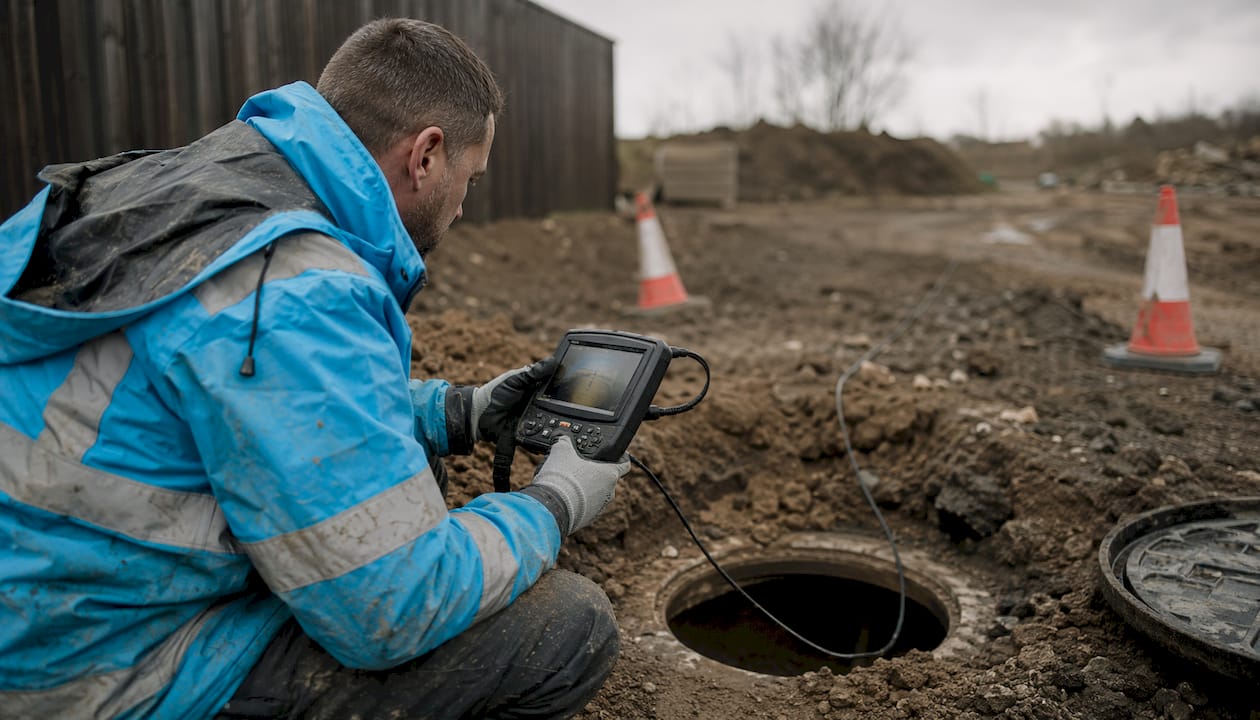
Camera carts or push-rod systems traverse the pipe interior, recording video and generating defect logs referenced to distance. Standard output is a coded defect report (WRc or equivalent grading). Best suited to gravity sewers and smaller-diameter pressure mains where access chambers exist. CCTV drain inspections are the default first field method for sewer condition programs across Victoria.
External acoustic leak detection
Surface listening devices and ground microphones detect leak noise transmitted through the pipe wall and surrounding soil. Effective on metallic and concrete mains; less reliable on PVC and PE because plastic attenuates acoustic signals. Low mobilization cost; no pipe access required.
Inline acoustic devices (tethered and free-swimming)
Internal acoustic devices get within inches of a leak, which allows precise location without the challenges of pipe material, diameter, and distance between listening points. Tethered devices can be deployed up to 4,000 feet but may be limited by butterfly valves and multiple bends. Free-swimming devices record acoustic data for extended periods and can be very small in diameter, making them viable for smaller distribution lines. Cost is generally significant per mile of pipe, reflecting the complexity of the technology.
Pressure, flow, and transient logging
Data loggers installed at hydrants, meters, or valve chambers record pressure and flow time series. Transient analysis identifies surge events that cause fatigue damage. Relatively low cost; no shutdown required; useful for network-wide screening before targeted field surveys.
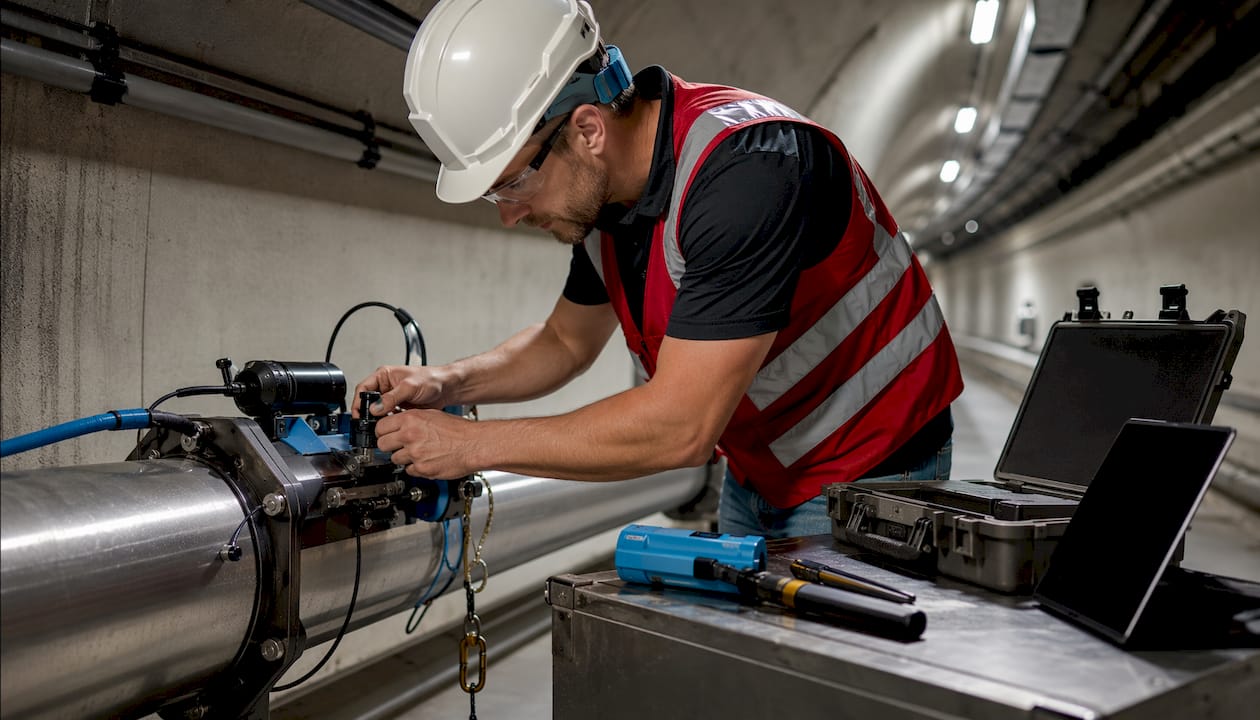
Electromagnetic (EM) wall-thickness surveys
EM tools create a magnetic field through the pipe wall; variations in wall thickness caused by corrosion or external damage alter the return signal. Effective on steel and ductile iron; ineffective on PVC, which does not corrode and does not carry a magnetic field. Larger access points are needed for internal tools; higher-resolution tools require access equivalent to the full pipe diameter. Costs are substantially higher than those for acoustic methods.
Ultrasonic thickness gauging
Converts an electrical pulse into a high-frequency sound wave that reflects off the pipe’s back wall. Accurate for measuring degradation depth on unlined steel; newer inline tools work on cement-mortar-lined steel and ductile iron. External spot-check gauging is low cost; inline ultrasonic tools carry similar cost premiums to EM inline tools.
Core sampling and laboratory analysis
Physical coupons cut from the pipe wall and tested for residual wall thickness, material properties, and corrosion products. Destructive but definitive; typically used to calibrate or verify EM/ultrasonic readings rather than as a primary survey method.
Method comparison
| Method | Resolution / what it detects | Best-fit pipe materials | Access requirements | Relative cost band |
|---|---|---|---|---|
| Desktop review | Segment risk ranking | All materials | Office only | Low |
| CCTV survey | Structural defects, infiltration, joint condition | Gravity sewers, small pressure mains | Access chambers or hydrant tees | Low–Medium |
| External acoustic | Leak location (surface) | Metallic, concrete | Surface only; no shutdown | Low |
| Inline acoustic (tethered / free-swimming) | Precise leak location | Metallic, concrete, HDPE | Insertion point; may need shutdown | Medium |
| Pressure / flow logging | Network anomalies, transients | All | Hydrant or valve access | Low |
| EM inline | Wall-thickness loss, corrosion pitting | Steel, ductile iron | Larger access point; shutdown | High |
| Ultrasonic (inline) | Wall-thickness, corrosion depth | Steel, ductile iron (lined) | Insertion point; shutdown | High |
| Core sampling | Material properties, corrosion confirmation | All (destructive) | Excavation required | Medium |
Equipment checklist for field teams:
- CCTV camera carts, push-rod systems, and recording units
- Acoustic listening devices (surface correlators, ground microphones)
- Inline acoustic sondes (tethered and free-swimming, with surface receivers)
- Pressure and flow data loggers with telemetry
- EM and ultrasonic NDT probes (handheld and inline)
- Core-sampling rigs and sample preservation kits
- GPS survey equipment for defect geo-referencing
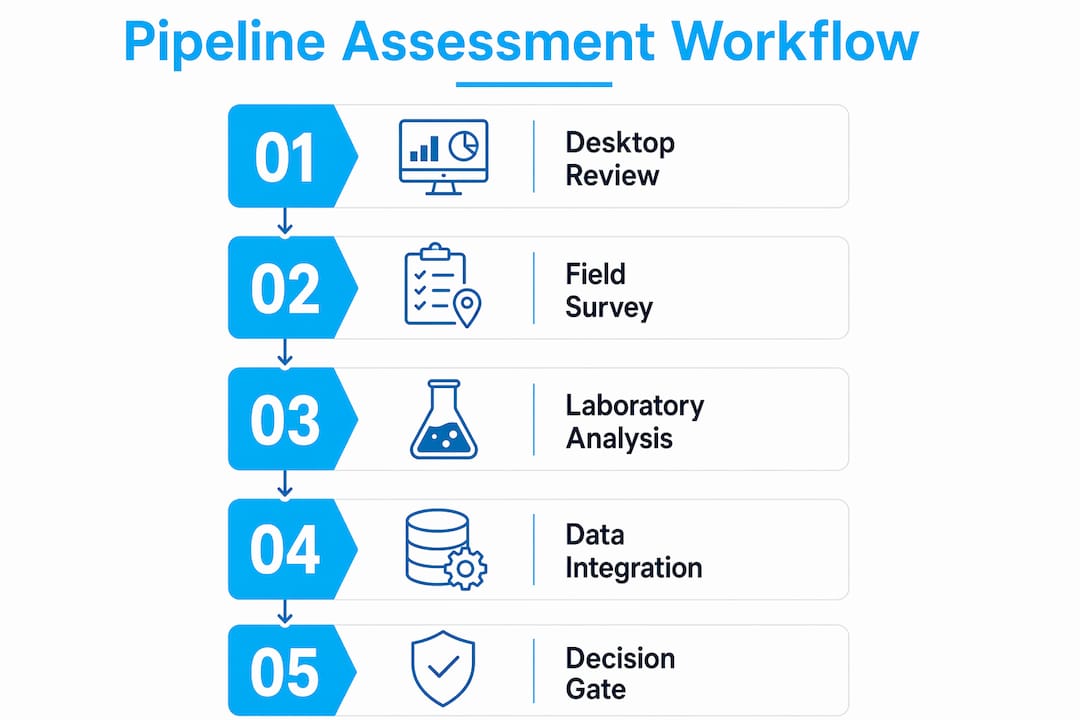
What does the assessment workflow look like from commission to close-out?
A well-structured pipeline health evaluation follows a logical sequence that keeps scope, cost, and deliverables aligned throughout.
- Procurement and briefing: Define objectives, asset IDs, acceptance criteria, data formats, and safety requirements. Reference AWWA’s action-planning guidance to structure the scope.
- Desktop review: Audit GIS records, as-built plans, hydraulic profiles, break history, and cathodic protection data. Identify high-risk segments and confirm method selection.
- Targeted field survey(s): Deploy the method or methods matched to pipe material, diameter, and access constraints. Collect raw data with GPS referencing and site safety records.
- Data analysis and condition grading: Process raw outputs against a defined grading schema. Flag anomalies for verification sampling or repeat runs.
- Options appraisal and cost estimates: Translate condition grades into remedial options (repair, reline, replace) with cost ranges and risk-weighted priorities.
- Reporting and GIS deliverables: Produce the final condition report, updated GIS layers, and asset register attributes.
- Close-out and monitoring plan: Agree on re-inspection intervals and any continuous monitoring triggers with the client.
Deliverables checklist:
- Site safety records and field data logs
- Raw data files (video, acoustic event lists, pressure time series, wall-thickness maps)
- Condition grading table referenced to asset IDs
- GIS shapefiles and attribute tables
- Recommended remedial priorities with cost ranges
- HSEQ documentation (safety plans, EPA compliance, crew certifications)
Quality assurance activities include repeatability checks on acoustic and EM readings, blind verification core samples at a defined sampling rate, and formal sign-off at the end of the desktop review phase before field mobilization is approved.
Pro Tip: Schedule the desktop review sign-off as a formal gate in the contract. Releasing field mobilization only after the desktop review is accepted prevents scope creep and avoids deploying the wrong tool to the wrong segment.
How do you integrate condition data into your asset management system?
Raw field data is only useful once it is normalized and linked to your asset register. The integration process follows a clear sequence.
Output types to expect:
- CCTV defect logs (coded to WRc or equivalent, with video timestamps)
- Acoustic event lists with GPS coordinates and confidence ratings
- Pressure and flow time series (CSV or equivalent, with logger metadata)
- Wall-thickness maps (EM or ultrasonic, referenced to pipe chainage)
- Core sample laboratory reports (material properties, corrosion rates)
- GIS shapefiles and attribute tables ready for ingestion into ArcGIS, QGIS, or equivalent
Condition grade schema and typical actions:
| Grade | Description | Typical action |
|---|---|---|
| Good | No significant defects detected | Routine monitoring; re-inspect per schedule |
| Fair | Minor defects or early-stage degradation | Increased monitoring frequency; plan for medium-term intervention |
| Poor | Significant defects; elevated failure risk | Schedule rehabilitation or targeted repair within 1–3 years |
| Critical | Imminent failure risk or active defect | Immediate intervention; escalate to capital program |
Integration steps:
- Ingest raw data files into the asset management platform (Infor, Maximo, TechnologyOne, or equivalent)
- Normalize records to asset IDs from the GIS register
- Append condition attributes (grade, defect type, confidence band, inspection date)
- Update renewal prioritization models and lifecycle cost projections
- Flag QA metadata: sensor tolerances, confidence bands, and any anomalies requiring re-inspection
Data format requirements should be specified in the contract before field work begins. Accepting data in a proprietary format that your AM system cannot ingest directly adds cost and delay at the back end of the project.
What financial and operational benefits does condition assessment deliver?
The case for condition assessment programs rests on converting unknown asset risk into quantified, manageable priorities. The financial logic is straightforward: targeted intervention on confirmed defects costs less than emergency response to unplanned failures, and it avoids the collateral costs of service disruption, traffic management, and environmental remediation.
Key benefits:
- Targeted repairs replace reactive break-fix cycles, reducing emergency callout costs
- Extended asset life through early intervention before defects become failures
- Better capital budget prioritization: spend where risk is highest, defer where condition is good
- Reduced customer impacts from unplanned outages
- Lower environmental risk from leaks, overflows, and contaminated excavations
- Documented condition evidence for regulatory reporting and insurance purposes
Converting assessment outputs to ROI for decision-makers:
The most persuasive framing for a capital committee is risk times consequence. A single large-diameter main failure in a metropolitan corridor can generate costs across emergency repair, traffic management, property damage, and regulatory penalties that dwarf the cost of a full assessment program. Presenting condition data as a risk-reduction investment, rather than a maintenance cost, shifts the conversation from “can we afford this?” to “what is the cost of not knowing?”
Linking assessment outputs to the annual budget cycle matters. Condition grades produced after the capital submission deadline have limited value for the current year. Build assessment timelines backward from budget submission dates.
How long does an assessment take, and what drives the cost?
Typical assessment timelines
| Assessment type | Typical duration |
|---|---|
| Desktop review | 1–3 weeks (depending on data availability) |
| CCTV survey (small distribution run, < 2 km) | 1–3 days field; 1 week reporting |
| External acoustic leak detection survey | 1–5 days field (network size dependent) |
| Inline acoustic survey (free-swimming) | 2–5 days field; 1–2 weeks analysis |
| EM or ultrasonic inline inspection | 3–10 days field; 2–4 weeks analysis |
| Core sampling and lab analysis | 1–2 days field; 2–4 weeks lab turnaround |
Main cost drivers
- Pipeline length and diameter: longer and larger pipes require more mobilization time and more data processing
- Access difficulty: limited valve spacing, deep chambers, or confined-space conditions add time and safety overhead
- Pipe material: metallic mains requiring EM or ultrasonic tools carry significantly higher equipment costs than PVC mains assessed by acoustic methods
- Shutdown and dewatering requirements: taking a main out of service adds coordination, bypass pumping, and customer notification costs
- Traffic management: works in live traffic corridors in Melbourne or regional Victorian towns require traffic control plans and permits
- Permitting: works on council roads or within utility easements may require additional approvals
- QA and reporting complexity: programs requiring blind verification samples, independent review, or regulatory-grade reporting carry higher costs
Pro Tip: Structure the scope in tiers: desktop review first, then targeted field surveys only on segments that the desktop review flags as high-risk. A tiered scope prevents unnecessary full-line campaigns and keeps the assessment cost proportional to the actual risk profile of the network.
How do you select and brief a capable provider?
Getting the procurement right protects the quality of the data and the usefulness of the final report. AWWA’s action-planning framework recommends defining the right questions before selecting a method, and the same logic applies to selecting a provider.
Procurement checklist:
- Defined assessment objectives (leak detection, structural grading, wall-thickness mapping, or a combination)
- Asset IDs, GIS records, and as-built plans provided to the provider for desktop review
- Acceptance criteria for each deliverable (condition grade schema, GIS format, report structure)
- Data format requirements specified (shapefile, geodatabase, CSV, video codec)
- Safety and insurance requirements stated (public liability minimums, EPA licensing, confined-space certification)
- Payment milestones tied to deliverable acceptance, not just field completion
Interview questions to vet provider capability:
- What equipment types do you deploy for this pipe material and diameter, and what are their detection limits?
- Can you demonstrate personnel qualifications for CCTV operation, acoustic survey, and NDT inspection?
- What past projects of similar scale and pipe type have you completed in Victoria or Australia?
- What safety accreditations does your crew hold, and is your EPA license current?
- What is your process for QA verification of field data before it is included in the final report?
- How do you handle unknown service crossings or contaminated fill encountered during potholing?
Sample scope language: “The provider shall deliver a condition grading table assigning each assessed pipe segment a grade of Good, Fair, Poor, or Critical, referenced to the asset IDs in the client’s GIS register, together with GIS shapefiles in ESRI format, a recommended remedial priority list with cost ranges, and HSEQ documentation. Payment milestone 2 is triggered by written acceptance of the condition grading table by the client’s asset manager.”
A practical project example: CCTV, acoustic survey, and NDD working together
The following example illustrates how a non-destructive assessment program typically unfolds when multiple methods and excavation support are combined.
Project overview: A Victorian water authority identified a 1.2 km section of aging ductile iron main with an elevated break frequency over the preceding three years. The desktop review confirmed aggressive soil conditions and gaps in cathodic protection records, flagging the segment as high-risk.
Methods deployed:
- CCTV survey of connected gravity sewer assets to rule out infiltration-driven soil loss
- Inline acoustic free-swimming device to locate active leaks along the pressurized main
- Non-destructive digging (NDD) / hydro excavation at three flagged locations to expose the pipe for external visual inspection and ultrasonic spot-check gauging
- Vacuum loading to manage spoil and groundwater during potholing
Outcomes:
- Two active leak points confirmed and located to within 0.5 m
- External corrosion pitting confirmed at one pothole location; wall-thickness loss measured at the NDT probe
- Targeted repair of two joints and one corroded section executed, avoiding full-main replacement
- Disruption limited to three discrete excavation sites rather than a corridor-wide open-cut program
Pressureworks crews operating under EPA-licensed procedures and current confined-space and traffic-management accreditations supported the potholing and vacuum loading phases of this type of program. Non-destructive digging eliminates the risk of secondary damage to adjacent services during exposure works, which is a material concern on aged corridors where as-built records are incomplete.
Trust signals relevant to this work type:
- EPA waste transport licensing for spoil and liquid waste removal
- Confined-space entry certification for crew members working in valve chambers
- Current public liability and professional indemnity insurance
- HSEQ procedures aligned with Victorian WorkSafe requirements
Why a tiered diagnostics approach is the research-backed standard
Academic and industry guidance consistently supports starting with low-cost screening methods and escalating only where risk and benefit justify it. The CBM literature recommends a practical maintenance mix weighted toward predictive and preventative activity, with reactive work reserved for genuinely unforeseen failures. Over-simplifying analytics risks false positives and erodes trust in the monitoring system over time.
The tiered diagnostic model for pipeline assets works as follows:
- Screen: Desktop review plus pressure/flow logging and external acoustic surveys. Low cost; covers the whole network; identifies segments that warrant closer attention.
- Confirm: CCTV survey or inline acoustic device on flagged segments. Confirms whether a suspected defect is real and locates it precisely.
- Quantify: EM or ultrasonic inline inspection, core sampling, or direct examination via NDD potholing. Defines the severity and extent of a confirmed defect to support a repair-versus-replace decision.
Each tier produces a decision gate. Moving from screen to confirm requires evidence from the screening phase that a segment’s risk profile justifies the additional cost. Moving from confirm to quantify requires a confirmed defect that cannot be adequately characterized by the confirmation method alone.
Pro Tip: Write decision gates into the contract as formal approval points. The client approves progression from screen to confirm, and from confirm to quantify, based on the outputs of the preceding tier. This prevents a provider from defaulting to the most expensive tool on every segment.
Key Takeaways
A structured, tiered pipeline condition assessment is the most cost-effective way for Australian utilities to convert unknown asset risk into prioritized, budgeted remedial action.
| Point | Details |
|---|---|
| Start with desktop review | Audit break history, pipe material, and cathodic protection data before mobilizing any field crew. |
| Match method to material | EM and ultrasonic tools work on steel and ductile iron; CCTV and acoustic methods suit PVC and gravity sewers. |
| Use tiered scopes | Screen the network first, then confirm and quantify only on high-risk segments to control cost. |
| Specify deliverables in the contract | Require condition grades, GIS shapefiles, costed remedial options, and HSEQ documentation as formal acceptance criteria. |
| Pressureworks for field support | Pressureworks provides NDD, hydro excavation, CCTV inspection, and vacuum loading across Victoria to support assessment programs. |
The case for getting the scope right before the truck rolls
Asset managers in water and wastewater often face pressure to commission a condition assessment quickly, particularly after a high-profile main break or a regulatory inquiry. The instinct is understandable, but the most common and costly mistake in pipeline integrity evaluation is deploying field resources before the desktop review is complete.
Integrating existing GIS data, hydraulic profiles, and as-built plans before site attendance makes the survey more surgical: it refines technology selection, reduces on-site time, and lowers overall cost. A desktop review that takes two weeks and costs a fraction of field rates can eliminate entire segments from the field scope, or redirect the survey to a section that was not originally flagged. That is not a delay; it is the assessment working as it should.
The second mistake is treating condition assessment as a one-time event rather than a program. Condition data ages. A grading produced five years ago on a main that has since experienced two additional breaks is not a reliable basis for a capital decision. Build re-inspection intervals into the monitoring plan from the start, and link them to the condition grades produced: a Critical segment warrants a short re-inspection cycle; a Good segment can wait longer. That structure is what converts a one-off survey into a genuine asset management pipeline program.
Pressureworks supports your pipeline assessment program across Victoria
When a condition assessment moves from desktop to field, the quality of the excavation and inspection support determines whether the data is usable. Pressureworks delivers non-destructive digging and hydro excavation across Victoria, providing precise, damage-free potholing that exposes pipe assets without risk to adjacent services. For utilities running CCTV programs, Pressureworks offers CCTV drain inspection services with full reporting outputs. Vacuum loading and suction truck services handle spoil and liquid waste removal in compliance with EPA licensing requirements.
To get an accurate quote, include your asset IDs, pipe material and diameter, access constraints, and the deliverable formats required from the procurement checklist above. Pressureworks crews hold current safety accreditations, confined-space certification, and EPA waste transport licensing, so your project meets Victorian regulatory requirements from day one. Contact Pressureworks to book a desktop assessment review or arrange a site visit for your next pipeline program.
Authoritative sources and further reading
- AWWA Manual M77 and Pipeline Condition Assessment Seminar — the primary industry reference for method selection, planning, and asset management integration
- Bartlett and West: Pipeline Condition Assessment Technologies for Rural and Regional Water Systems — practical technology review covering acoustic, EM, and ultrasonic methods with cost and access guidance
- AWWA Opflow: Develop an Action Plan for Pipeline Condition Assessment — action-planning framework for utilities making system-specific decisions
- MDPI: Practical Application of Condition-Based Monitoring Technologies — academic review of CBM practicality, tiered diagnostics, and analytics decision rules
- US 49 CFR §195.416 — US regulatory example illustrating documented assessment methodology and periodic reassessment requirements; Australian utilities should reference the relevant state and federal pipeline safety regulations and Water Services Association of Australia (WSAA) guidelines for their jurisdiction