

If your project involves any trenching, excavation, or utility connection within a road reserve in Victoria, you almost certainly need a road opening permit (ROP) or works-within-road-reserve consent before a single shovel breaks ground. The first action is straightforward: identify who manages the road you’re working on, because that single determination drives every subsequent step.
Before you do anything else, confirm these three things:
- Road type: Is it a local council road, an arterial road, or a freeway reserve? Local roads go through council; arterial and freeway reserves go through Transport Victoria.
- Excavation size: Is the disturbed area under 8.5 sqm? That threshold separates a standard road opening permit from a works-within-road-reserve consent at councils like City of Darebin.
- Traffic control scope: Will you need major traffic control items? If so, a Memorandum of Authority (M.O.A.) from the coordinating road authority may be required before council can issue your permit.
Pro Tip: Save the council’s engineering or roads team contact number before you lodge. A five-minute call to confirm the road classification and excavation threshold can prevent a full reapplication.
Table of Contents
- What does a road opening permit actually cover?
- Quick checklist: what to include in your permit application
- How to prepare and lodge a compliant application in Victoria
- Who approves your permit: council or Transport Victoria?
- Why applications get delayed or refused, and how to fix them
- How non-destructive digging helps get permits approved faster
- Sample submission checklist and realistic timetable
- What to expect after your permit is approved
- Key Takeaways
- What experienced Victorian project teams do differently
- Pressureworks helps you reduce permit risk from the start
- Useful sources for your application
What does a road opening permit actually cover?
A road opening permit is the formal consent from a road authority to physically disturb the road reserve. The road reserve extends beyond the sealed carriageway and typically includes the nature strip, footpath, kerb and channel, and the road surface itself. Works-within-road-reserve consent is a related but distinct authorization used for larger or more complex interventions.
Common activities that trigger a permit requirement include:
- Utility service connections, maintenance, or repairs (water, gas, electricity, telecommunications)
- Trenching and horizontal or vertical bores
- Footpath construction or repair
- Stormwater and drainage connections
- Kerb and channel works
- Any excavation within the nature strip or road pavement
The City of Kingston confirms a road opening permit is required for any digging within the road reserve, and the permit fee is $257.50. The City of Bayside requires a fee of $297.00 and a minimum of 5 business days for assessment for its road opening permit. Size thresholds matter too: Darebin applies the road opening permit pathway only for smaller excavations below a certain size threshold. Larger areas require the works-within-road-reserve consent pathway, which carries a different application process and longer assessment window. Emergency works may proceed without prior consent in genuine urgent situations, but the relevant authority must be notified as soon as practicable.
Quick checklist: what to include in your permit application
Getting your submission right the first time is the single best way to hit your project start date. Councils and Transport Victoria assess applications against a defined set of documents, and missing even one item triggers a request for further information that resets the clock.
Documents to prepare:
- Dimensioned site plan with photos of existing conditions
- Traffic Management Plan (TMP) or Traffic Guidance Scheme (TGS) compliant with AS 1742.3 2019, prepared by a qualified person
- Certificate of currency for public liability insurance (City of Boroondara references a common council expectation for substantial coverage)
- Contractor ABN and evidence of capability; some councils, including Boroondara, require the applicant to be a genuine contractor rather than a private individual
- Legal point of discharge documentation for any stormwater or drainage works
- Reinstatement schedule and materials specification
Fee and timeline reference table:
| Council / Authority | Permit Fee | Assessment Target |
|---|---|---|
| City of Bayside | $297.00 | minimum 5 business days |
| City of Kingston | $257.50 | assessment period not listed |
| City of Darebin | fee not publicly listed | up to 10 business days once required information received |
| Transport Victoria | fee not publicly listed | 20 business days |
Permits are commonly valid for three months from issue date. Plan your construction schedule around that window. For stormwater works, a legal point of discharge must be obtained before the permit can be issued.
Pro Tip: Insurance and TMP quality are the most common first points of failure. Have your certificate of currency and a compliant TMP ready before you lodge, not after the council requests them.
How to prepare and lodge a compliant application in Victoria
Follow these steps in order, and you’ll avoid the most common causes of delay.
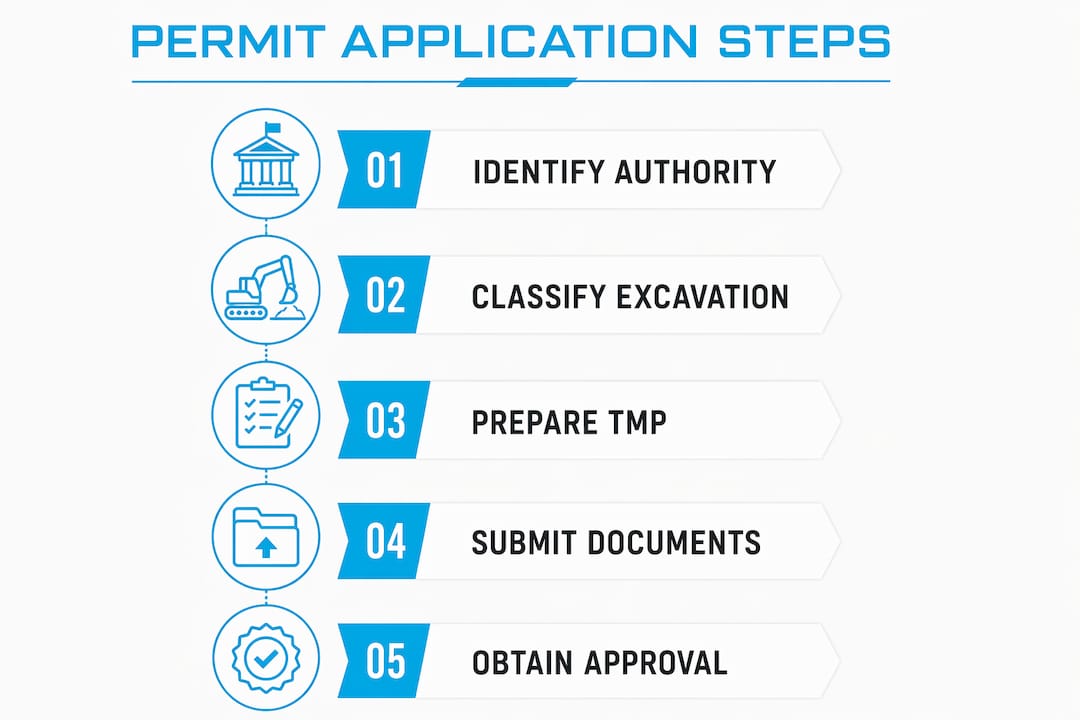
- Identify the coordinating road authority. Confirm whether the road is managed by the local council or Transport Victoria. Arterial roads and freeway reserves require Transport Victoria involvement.
- Prepare your documents in parallel. Your TMP/TGS, insurance certificate, site plan, and contractor credentials can all be prepared simultaneously. Don’t wait for one before starting another.
- Check excavation classification. Confirm whether your disturbed area falls under the road opening permit threshold or requires works-within-road-reserve consent. Misclassification causes reapplications.
- Lodge the application and pay the fee. Submit the complete package, including all supporting documents, to the relevant authority. Incomplete submissions are the leading cause of extended assessment times.
- Manage pre-start notifications. Some councils require notification before works commence. Confirm this requirement at lodgement.
- Carry out works under the approved TMP and keep the permit on site. The permit must be physically present at the work location throughout the project.
- Book reinstatement inspections early. Councils like Kingston require formwork inspections before concrete pours. Book these as soon as your works schedule is confirmed.
For drainage connections, secure the legal point of discharge from the council’s drainage team before lodging the road opening permit application, since the permit cannot be issued without it.
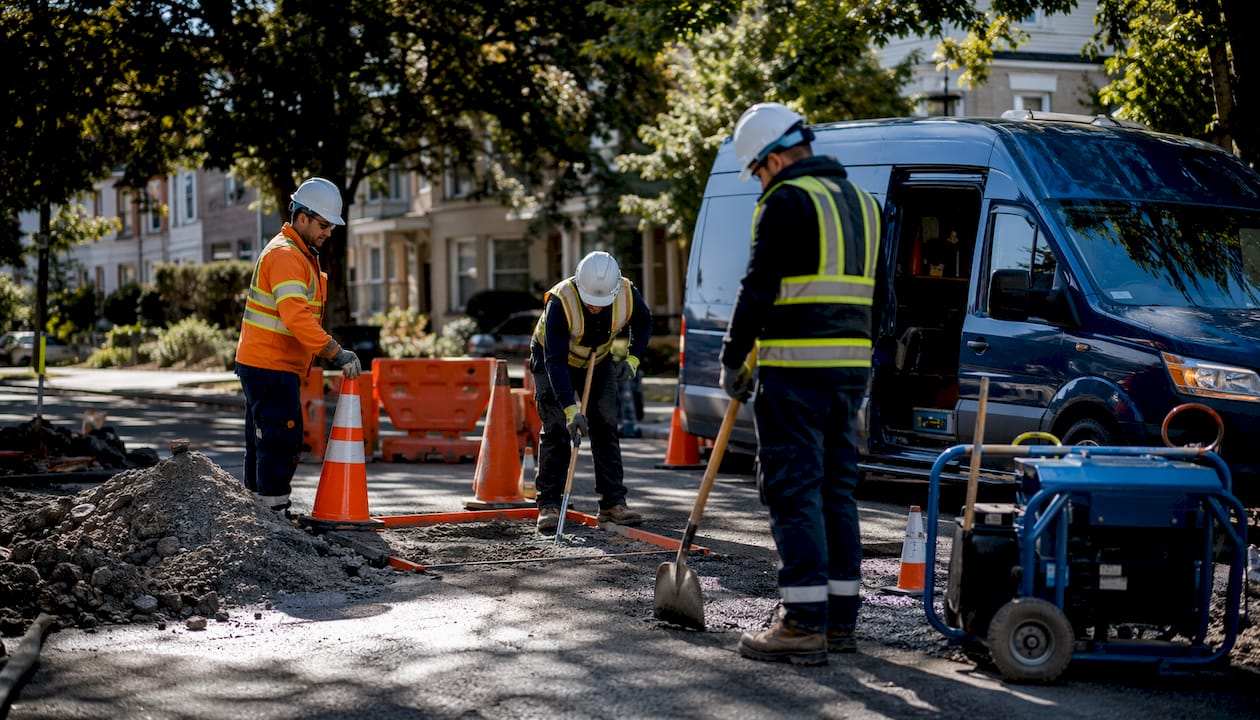
Who approves your permit: council or Transport Victoria?
Local councils handle the majority of road opening permits for municipal roads. Transport Victoria acts as the coordinating road authority for arterial roads, freeways, and some higher-speed corridors. Getting this wrong means lodging with the wrong authority and losing weeks.
Transport Victoria reviews applications against three criteria: road safety, network efficiency, and community access. Its target response time is 20 business days. If Transport Victoria does not respond within that window, written consent may be deemed granted, but all conditions still apply.
For arterial roads, a Memorandum of Authority is often required. The M.O.A. is a separate step that must be completed with the coordinating road authority before the local council can finalize your permit. City of Bayside explicitly notes that an M.O.A. is required from the coordinating road authority for work on relevant road types and when major traffic control items are used.
After works are complete, you must notify the coordinating road authority within seven business days, including reinstatement details. Utilities may have extended notification windows in some cases.
Pro Tip: If your project touches an arterial road, request the M.O.A. at the same time you begin preparing your TMP. The M.O.A. process runs in parallel and can otherwise become the critical path item that delays your start date.
Why applications get delayed or refused, and how to fix them
Most delays trace back to a small set of avoidable problems.
- Non-compliant TMP/TGS: The plan must comply with AS 1742.3 2019 and be prepared by a qualified person. A plan prepared by someone without the right accreditation will be rejected outright.
- Insufficient insurance: Councils expect a current certificate of currency. Boroondara references $20M public liability as a common expectation. Check the specific council’s requirement before lodging.
- Wrong authority identified: Lodging a council application for an arterial road wastes time. Confirm road classification first.
- Incomplete site plans: Missing dimensions, no reinstatement materials specification, or absent pre-works photos all trigger information requests.
- Misclassified excavation size: Applying for a road opening permit when the area exceeds the 8.5 sqm threshold means reapplying under the works-within-road-reserve consent pathway.
- Ineligible applicant: Some councils will not accept applications from private individuals. The applicant must be a contractor with a valid ABN.
Pro Tip: Call the council’s engineering team before lodging if you’re unsure about excavation classification. A brief conversation clarifying whether your job is a road opening permit or works-within-road-reserve consent prevents a full reapplication.
How non-destructive digging helps get permits approved faster
Using non-destructive digging (NDD) or hydro excavation as your planned excavation method strengthens your permit application in several concrete ways.
- Smaller excavation footprint: NDD exposes utilities with precision, often keeping the disturbed area well under the 8.5 sqm threshold and within the simpler road opening permit pathway.
- Reduced reinstatement scope: Less pavement removed means a simpler reinstatement plan, which councils find easier to approve.
- Lower risk to underground assets: Documenting NDD as the planned method demonstrates to councils that you’ve considered asset protection, which directly addresses Transport Victoria’s road safety criterion.
- Cleaner site plans: Precise excavation boundaries make dimensioned site plans more accurate and easier to assess.
Pressureworks’ hydro excavation and vacuum loading services are specifically suited to the tight urban digs common in Melbourne and regional Victoria, where underground utility density is high and reinstatement standards are strictly enforced. Specifying NDD in your permit application as the planned excavation method is a practical way to demonstrate compliance intent and reduce assessor queries.
Pro Tip: Include a brief method statement in your site plan describing how NDD limits the excavation footprint. Councils respond well to applications that show the contractor has thought through reinstatement from the start.
Sample submission checklist and realistic timetable
Use this as a project planning reference before you mobilize.
Submission checklist (in order):
- Confirm coordinating road authority (council vs. Transport Victoria)
- Classify excavation size (under or over 8.5 sqm)
- Prepare dimensioned site plan with pre-works photos
- Commission TMP/TGS to AS 1742.3 2019
- Obtain certificate of currency (confirm required limit with council)
- Gather contractor ABN and capability evidence
- Obtain legal point of discharge (drainage works only)
- Complete application form and pay permit fee
- Request M.O.A. from coordinating road authority (arterial roads)
- Confirm pre-start notification requirements
Sample planning timetable:
| Task | Realistic Lead Time |
|---|---|
| Confirm authority and road classification | Day 1 |
| Prepare TMP, site plan, insurance (parallel) | Days 1–5 |
| Lodge application with council | Day 6 |
| Council assessment (Bayside example: 5 business days minimum) | Days 7–10 |
| Transport Victoria assessment (arterial: 20 business days) | Days 7–30 |
| Darebin assessment (up to 10 business days once information received) | Days 7–15 |
| Permit issued; schedule works within 3-month validity | Post-approval |
| Book reinstatement inspection | Before works complete |
| Notify coordinating road authority post-completion | Within 7 business days |
Build a buffer of at least three to five business days beyond the council’s stated target. Information requests reset the assessment clock, and even a single missing document can push your start date by a week or more.
What to expect after your permit is approved
Approval is not the end of the compliance process. Permit conditions are legally binding, and failing to meet them can result in fines, permit cancellation, or a requirement to reapply.
Common conditions attached to road opening permits include:
- The permit must be kept on site and available for inspection at all times
- The approved TMP must be active and correctly implemented before works begin
- Traffic control must be set up in accordance with the approved plan
- Reinstatement must be completed within the specified period (Boroondara references 28 days as a common requirement)
- Pre-works site condition photos must be taken before any ground is disturbed
- Completion notification must be submitted to the coordinating road authority within seven business days of finishing works, including reinstatement details
If your permit expires before reinstatement is complete, you will need to reapply. Councils treat permit expiry as a compliance trigger, and reinstatement materials and concrete or asphalt work must match the council’s specified standards. Book your reinstatement inspection as early as possible, since inspection slots fill quickly in busy periods.
Pro Tip: Take a full set of pre-works photos the morning works begin, not the day before. Councils use these photos to assess reinstatement quality, and a time-stamped record protects you if a dispute arises.
Key Takeaways
A road opening permit in Victoria requires identifying the correct road authority, classifying excavation size, and submitting a compliant TMP, valid insurance, and a complete site plan before works begin.
| Point | Details |
|---|---|
| Identify the right authority first | Local council handles municipal roads; Transport Victoria handles arterial and freeway reserves. |
| Excavation size determines the pathway | Under 8.5 sqm typically qualifies as a road opening permit; larger areas require works-within-road-reserve consent. |
| Insurance and TMP are the top failure points | Have a certificate of currency and an AS 1742.3 2019-compliant TMP ready before lodging to avoid assessment delays. |
| Build time buffers into your schedule | Bayside targets a minimum of 5 business days response; Transport Victoria aims for 20 business days; Darebin targets up to 10 business days once complete information is received. |
| Pressureworks NDD reduces permit risk | Specifying hydro excavation limits excavation footprint, simplifies reinstatement plans, and demonstrates asset protection to councils. |
What experienced Victorian project teams do differently
The contractors who move through the permit process fastest share one habit: they treat the TMP and reinstatement plan as pre-lodgement deliverables, not post-approval tasks. By the time they submit, those documents are already complete and compliant. That approach eliminates the most common cause of extended assessment times.
Briefing the council’s engineering officer before lodging is equally valuable. A short conversation about road classification, excavation scope, and reinstatement materials often surfaces requirements that aren’t obvious from the online application guide. It also puts a name to your application, which can matter when the assessor has a question.
The M.O.A. step on arterial roads catches teams off guard more often than any other single item. It’s a separate process with its own lead time, and treating it as an afterthought routinely adds weeks to project schedules. Budget for it from day one.
Specifying NDD as the planned excavation method in the application is a practical differentiator. It signals to the assessor that the contractor has considered reinstatement scope and underground asset risk from the outset, two factors that directly influence how quickly an application moves through assessment.
Pressureworks helps you reduce permit risk from the start
When the excavation method you specify in your permit application directly affects how quickly councils approve it, the choice of contractor matters. Pressureworks provides hydro excavation and NDD services across Melbourne and Victoria that reduce excavation footprints, simplify reinstatement obligations, and give your permit application a stronger technical foundation.
For projects where underground utility density is high or reinstatement standards are strict, Pressureworks’ vacuum loading and suction truck capabilities handle spoil removal efficiently, keeping the site clean and inspection-ready. The team works directly with civil contractors, utility managers, and councils on projects where permit compliance and minimal disruption are non-negotiable.
Contact Pressureworks for a scoped quote on your next road opening or utility works project in Victoria.
Useful sources for your application
Use these primary references to confirm current requirements and fees for your specific work area.
- Transport Victoria: Working within the road reserve — approval criteria, 20 business day response target, M.O.A. and completion notification requirements
- City of Bayside: Apply for a Road Opening Permit — $297.00 fee, 5 business day minimum, M.O.A. and photo requirements
- City of Kingston: Vehicle crossing and road opening permits — $257.50 fee, scope of works covered
- City of Boroondara: Road Opening Permit — TMP/TGS requirements to AS 1742.3 2019, insurance expectations, reinstatement conditions
- City of Darebin: Road opening permit and works within road reserve consent — 8.5 sqm threshold, up to 10 business day assessment, 3-month permit validity
Always check the coordinating road authority’s current guidance directly before lodging. Requirements and fees are updated periodically, and the council’s engineering team can confirm whether your project requires an M.O.A. or works-within-road-reserve consent before you commit to a submission.
This article provides general information about road opening permit processes in Victoria. Requirements vary by council and road type. Confirm current conditions with the relevant road authority or a qualified professional before lodging your application.
Recommended
- Non Destructive Digging Melbourne: Why Civil Contractors Prefer NDD – Pressure Works
- Non-Destructive Digging Melbourne: Why Civil Contractors Prefer NDD – Pressure Works
- NDD Melbourne: Why Non-Destructive Digging is the Smart Choice for Civil Contractors and Plumbers – Pressure Works
- Blogs – Pressure Works