

For most hydro excavation and potholing jobs on Victorian civil and utility sites, a combo vacuum truck with a debris range suited to most site access and spoil volumes is the practical starting point. That bracket covers the majority of service openings, utility faulting, and trench excavations without creating access or weight problems on constrained urban sites. For liquid-only hauling and municipal sludge removal, capacities vary widely from smaller sucker trucks to large tractor-trailer configurations with very large tanks.
The immediate selection driver is not the biggest tank you can get on site. It is matching your estimated daily spoil volume to the number of loads you can realistically complete, given travel time, disposal queue, and site access. A 12,000 L truck that cannot fit down a Melbourne laneway or that exceeds legal axle limits when full is less productive than a well-specified 7,600 L unit with 4,131–6,400 CFM airflow and a crew that completes four clean cycles per shift.
Quick capacity reference for common job types:
- Potholing and service openings (urban): 6,000–8,000 L combo unit; maneuverability and water capacity matter most
- Utility faulting and trench excavation: 7,600–9,200 L combo; prioritize airflow (CFM) over raw tank volume
- Drain and pit cleaning: 6,000–8,500 L liquid/combo; confirm hose diameter and boom reach
- Municipal sludge and civil cleanouts: 8,500–12,000 L; straight suction or high-volume liquid tanker
- Bulk liquid transport (long haul): 15,000–25,000+ L tractor-trailer configuration
Table of Contents
- How is vacuum truck capacity measured, and what ranges will you see in Australia?
- What do the different types of vacuum trucks mean for usable capacity?
- Which performance specs matter as much as tank volume?
- How do you choose the right vacuum truck capacity for your job?
- Which capacity suits your specific job type?
- What regulatory and operational constraints reduce your usable capacity in Australia?
- Why Pressureworks is a practical choice for capacity-matched vacuum services
- Key Takeaways
- Capacity matching matters more than contractors usually expect
- Pressureworks: capacity-matched vacuum services for Victorian contractors
- Useful sources for specs, regulations, and manufacturer data
How is vacuum truck capacity measured, and what ranges will you see in Australia?
Manufacturers quote tank volume in three units depending on their market: liters (L), cubic meters (m3), and US gallons (gal). The conversions are straightforward: 1 m3 equals 1,000 L, and 1 US gallon equals approximately 3.785 L. Where you see cubic yards, 1 yd3 converts to roughly 0.765 m3. Australian suppliers typically advertise in liters or cubic meters, but imported spec sheets from North American manufacturers often use US gallons or cubic yards, so conversion is a routine step when comparing quotes.
Debris body (spoil) capacities for vacuum trucks range from approximately 3.8 m3 (5 yd3) on smaller utility units to over 11.5 m3 (15 yd3) on heavy-duty models. The Vermeer VXT series, one of the more widely referenced excavation-class platforms, is offered in 6.1 m3, 7.6 m3, and 9.2 m3 debris body configurations. Liquid-only tanks start around 3,000 L for compact civil units and scale to over 25,000 L for large tractor-trailer rigs used in municipal and industrial liquid transport.
| Configuration | Typical tank range | Common units used |
|---|---|---|
| Small utility / potholing | 3.8–6.1 m3 (3,800–6,100 L) | L or m3 |
| Mid-size hydro excavation | 6.1–9.2 m3 (6,100–9,200 L) | L or m3 |
| Heavy-duty debris body | 9.2–11.5 m3 (9,200–11,500 L) | m3 or yd3 |
| Liquid-only civil/municipal | 3,000–8,500 L | L |
| Large tractor-trailer liquid | 15,000–25,000+ L | L or kL |
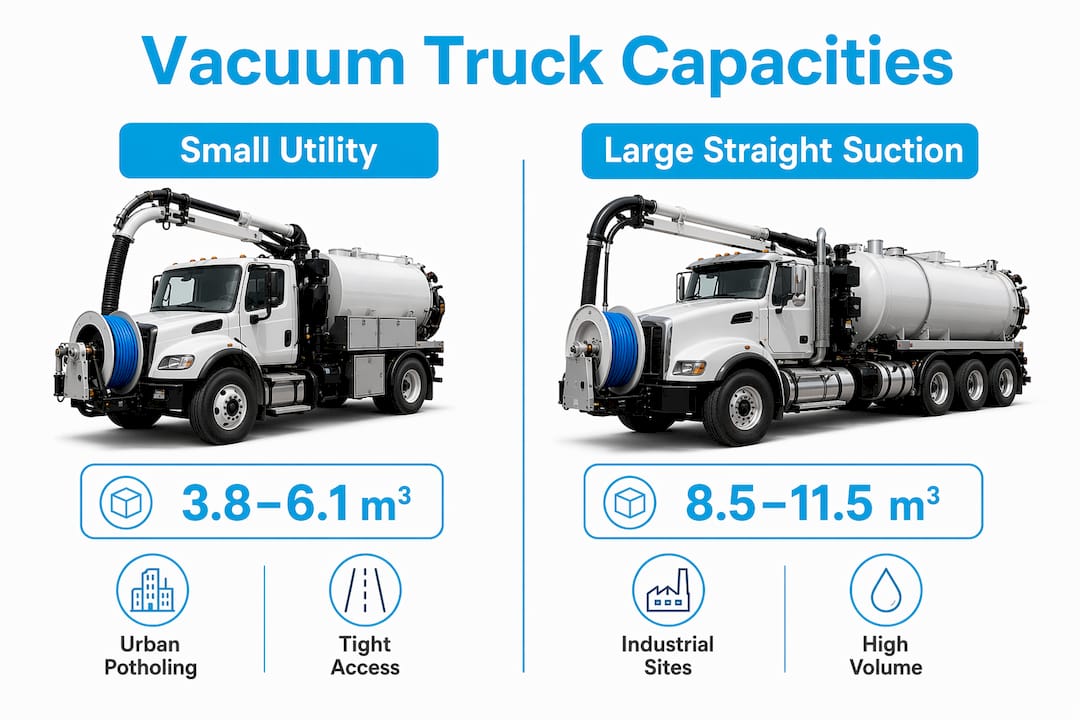
Combo or hydro-excavation trucks carry both a fresh water tank and a debris tank within the same overall vehicle envelope. That partitioning is the critical detail: a 10,000 L combo truck might carry 6,500 L of debris capacity and 3,500 L of water, not 10,000 L of usable spoil. Always ask the supplier for the debris-to-water split, not just the headline tank figure.
Key unit-conversion reminders:
- 1 m3 = 1,000 L
- 1 US gallon = 3.785 L
- 1 yd3 = 0.765 m3 (765 L)
- 1,500 US gal ≈ 5,678 L (a common water tank size on combo units)
What do the different types of vacuum trucks mean for usable capacity?
Understanding the three main truck types prevents a common quoting mistake: comparing a straight suction truck’s headline volume directly against a combo unit’s headline volume as though they are equivalent.
Straight suction trucks
These units carry a single tank dedicated entirely to debris or liquid waste. There is no water partition, so the full advertised volume is available for spoil or liquid. They are the right choice for drain cleaning, pit cleanouts, liquid waste haulage, and any job where water is supplied separately or not needed. A straight suction truck with an advertised tank size delivers its full volume to the job. Models fitted with appropriate vacuum pumps provide sufficient flow capacity for liquid and semi-liquid waste.
Combo and hydro-excavation trucks
Combo units partition space for fresh water and debris, so effective spoil volume is lower than a straight suction truck of similar overall size. A straight-suction unit carries its full volume as debris, while a combo unit’s usable debris capacity depends on the water tank size within the total volume. The water-to-debris ratio is the single most important spec for hydro excavation efficiency. For remote or long-distance work, prioritizing a larger water tank reduces refill frequency even if it slightly reduces debris volume per load.
Vactor-style combo units offer large debris bodies and water tanks, illustrating that water capacity significantly occupies the total tank volume in combo trucks.
Liquid tankers and sucker trucks
Liquid tankers are optimized for high-volume liquid waste and are not suited to dry or semi-dry spoil. They come in a range of capacities suitable for various liquid waste applications. These units are appropriate when the job is purely liquid haulage and excavation is not required. For a more detailed breakdown of how vacuum trucks and sucker trucks differ in practice, the vacuum truck vs. suction truck comparison covers the functional distinctions that affect capacity decisions.
Pro Tip: Always ask the supplier to confirm “usable” or “effective” spoil capacity, not just geometric tank volume. Debris tanks should never be filled to 100% because airflow must be maintained to protect the vacuum pump. Many units include load-limit sensors for exactly this reason. The practical fill factor is typically 85–90% of geometric volume at most.
Which performance specs matter as much as tank volume?
Tank size tells you how much a truck can hold. Airflow and vacuum rating tell you how fast it can fill that tank, and how effectively it can move dense or wet material. On excavation jobs, a truck with higher airflow often outperforms a larger but lower-powered unit because it completes more cycles per shift.
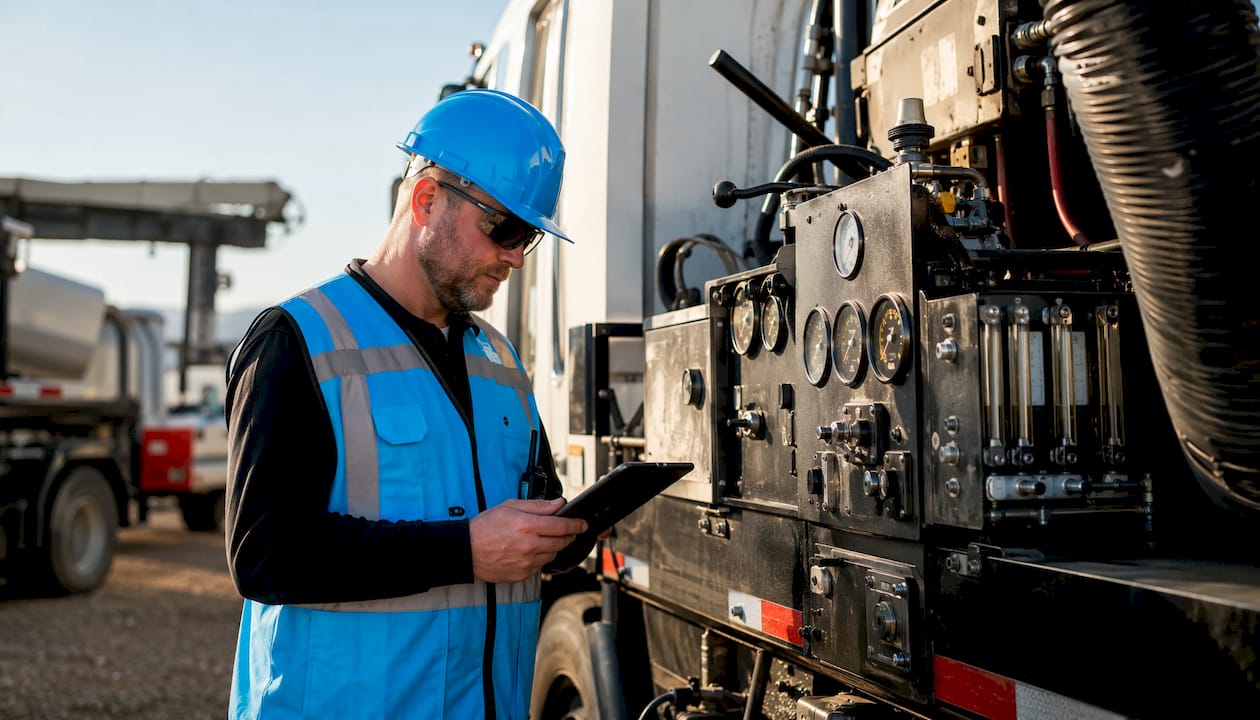
Airflow (CFM) measures the volume of air the blower moves per minute. Vermeer VXT models deliver airflow from 4,131 CFM to 6,400 CFM depending on configuration. Vactor units list inlet volumes up to 5,000 CFM. Supervac’s ENYO wet/dry platform reaches 6,400 CFM at 27 inHg. For municipal and high-volume civil work, higher CFM reduces cycle time per excavation and can be more economical than additional trips with a larger but lower-powered tank.
Vacuum rating (inHg) measures the suction depth the pump can generate. Ratings up to 27 inHg are common on excavation-class units and allow effective material lift from greater depths. Positive displacement (PD) blowers typically achieve higher inHg ratings than centrifugal fans, making them better suited to dense or wet spoil.
Key spec benchmark: Excavation-class vacuum trucks typically target 4,500+ CFM airflow and 25–27 inHg vacuum rating for productive potholing and utility exposure work.
Additional specs that directly affect on-site productivity:
- Suction hose diameter: Standard sizes run from 100 mm (4 in) on smaller units to 200 mm (8 in) or larger on heavy-duty models. A wider hose moves more material per stroke and handles larger debris fragments without blockage.
- Boom reach: Hydraulic booms on combo units typically extend 6–8 m, which determines how far from the truck the operator can work without repositioning.
- Water pump output (GPM/PSI): Hydro excavation requires sufficient water pressure to break soil. Common specs range from 9.5 GPM at 5,800 PSI on compact units to 80 GPM at 2,000 PSI on high-volume platforms. UDOR pumps are a common choice on mid-range hydro excavation builds; Jurop handles the vacuum side on many liquid waste units.
- Blower type: Positive displacement blowers (Jurop, Roots-type) suit dense liquid and wet spoil. Centrifugal fans move higher air volumes but at lower vacuum depth. Confirm which blower type the quoted unit uses before committing to a hire or purchase.
A common spec presentation issue: some vendors advertise the blower’s peak CFM at zero static pressure, which is higher than the working CFM under load. Ask for the CFM figure at the operating vacuum rating, not the free-air peak.
How do you choose the right vacuum truck capacity for your job?
A repeatable selection method starts with spoil volume, not with the truck catalog.
Step-by-step selection process
- Estimate total spoil volume for the job. For a trench: length (m) × width (m) × depth (m) = volume in m3. For a pothole: use π × radius2 × depth. Add 15–20% for bulking factor (excavated soil expands when loosened).
- Divide total spoil by your target loads per day. If you need to move 12 m3 of spoil and plan four loads per shift, you need a truck with at least 3 m3 usable capacity per load. If you can only complete two loads per shift due to disposal distance, you need 6 m3 usable per load.
- Apply the fill factor. Usable capacity is typically 85–90% of geometric tank volume. A 9,200 L (9.2 m3) debris body delivers roughly 7,800–8,300 L of practical spoil per load.
- Check GVM and axle loads. Confirm the truck’s tare weight, add the weight of a full debris load (wet spoil averages approximately 1.5–1.8 t/m3), and verify the total does not exceed the legal GVM or axle limits for your route. A large advertised tank may be legally unusable at full volume on Australian roads.
- Confirm water capacity for combo units. For hydro excavation, calculate your water consumption rate per pothole or trench metre and confirm the water tank supports your planned work cycle without mid-shift refills.
- Factor in non-productive time. Travel to disposal, queue time at the tip, washdown, and refill all reduce the number of loads per shift. These non-productive minutes are often the primary driver of how many loads are feasible per day.
Worked example: potholing for a utility corridor
A crew is potholing 20 service locations along a Melbourne suburban street. Each pothole is approximately 0.5 m × 0.5 m × 1.5 m deep = 0.375 m3 geometric, or roughly 0.45 m3 with bulking. Total spoil: 20 × 0.45 m3 = 9 m3. With a 7,600 L (7.6 m3) combo unit at 87% fill factor, usable capacity is approximately 6,600 L (6.6 m3) per load. That means two loads to clear the day’s spoil, leaving time for travel and disposal. A 6,100 L unit would require the same two loads with less margin. A 9,200 L unit would clear the job in a single load but may face access restrictions on a narrow residential street.
Pro Tip: When calculating daily cycles, add at least 45–60 minutes of non-productive time per load for travel, tipping queue, and washdown. On inner-city Melbourne jobs with congested routes to licensed disposal facilities, that buffer often extends to 90 minutes per cycle.
Supplier checklist questions
- What is the usable (effective) spoil capacity, not just geometric volume?
- What is the water tank volume and the debris-to-water split?
- What are the airflow (CFM) and vacuum rating (inHg) at operating conditions?
- What is the suction hose diameter and maximum boom reach?
- What is the truck’s tare weight and GVM?
- Is the unit EPA-licensed for the waste types on this project?
- What disposal options and permits does the operator hold?
Red flags in a quote: no usable capacity figure (only geometric), missing blower or pump specs, no GVM or tare weight data, and no mention of EPA licensing or waste classification.
Which capacity suits your specific job type?
| Job type | Recommended capacity | Key reason |
|---|---|---|
| Urban potholing (tight access) | 6,000–7,600 L combo | Maneuverability; 2–3 loads per shift typical |
| Utility faulting and cable exposure | 7,600–9,200 L combo | Balance of water and debris; higher CFM priority |
| Drain and pit cleaning | 6,000–8,500 L liquid/combo | Hose diameter and boom reach critical |
| Large civil cleanouts | up to 11,500 L straight suction | Maximum debris volume; no water partition needed |
| Municipal sludge removal | up to 12,000 L liquid tanker | High liquid density; GVM compliance critical |
| Bulk liquid transport (regional) | up to 25,000+ L tractor-trailer | Long haul; disposal frequency drives size |
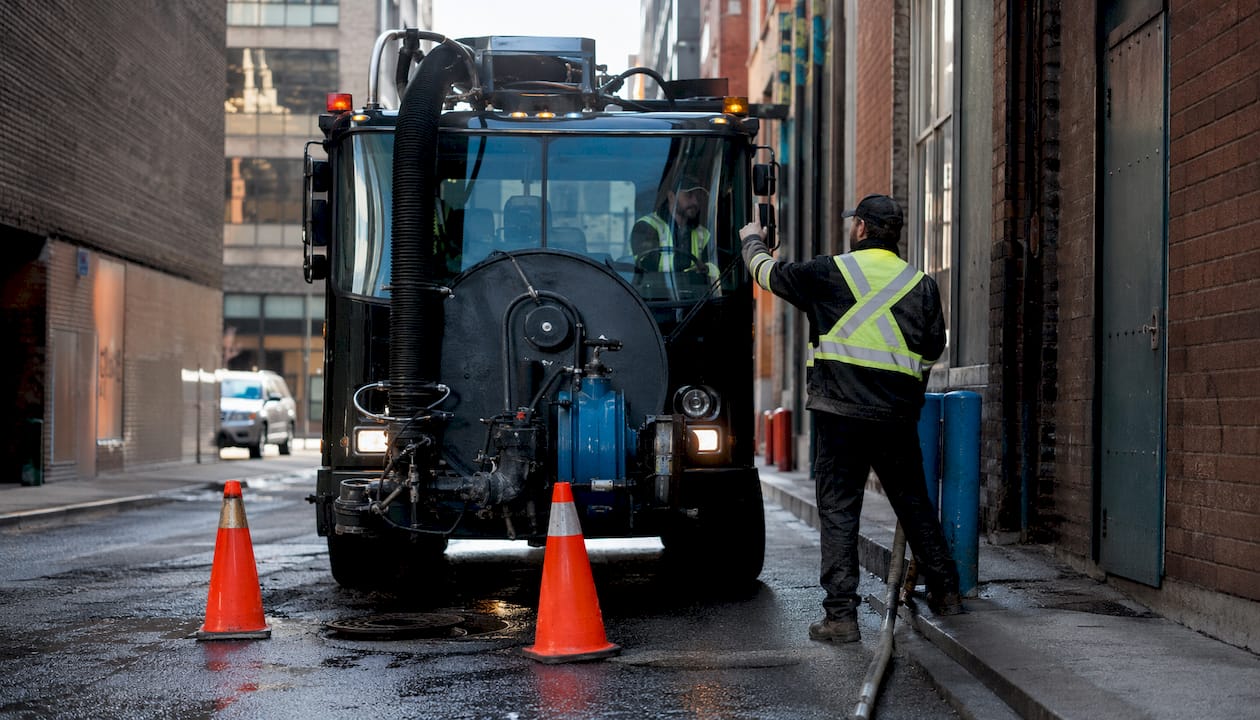
For inner-city Melbourne jobs, the 6,000–7,600 L range is the practical ceiling for most sites. Narrow laneways, overhead clearances, and traffic management zones on arterial roads frequently rule out larger rigid trucks. Regional Victorian sites, by contrast, often accommodate 9,200 L or larger units without access problems, and the longer travel distances to disposal facilities make larger tanks more economical per cycle.
For high-volume vacuum loading on industrial or municipal sites, a straight suction unit in the 8,500–11,500 L range avoids the water partition penalty and maximizes payload per trip. When planning disposal logistics for large spoil volumes, coordinating with a skip bin service for temporary on-site storage can reduce truck idle time between loads.
What regulatory and operational constraints reduce your usable capacity in Australia?
Published tank volume and legal working capacity are not the same number on Australian roads, and the gap can be significant.
GVM and axle load limits are the primary constraint. A truck’s gross vehicle mass is the sum of its tare weight plus the load. Wet spoil typically weighs 1.5–1.8 tonnes per cubic meter; liquid waste can reach 1.0–1.1 t/m3. A 9,200 L debris body filled with wet clay spoil at 1.7 t/m3 adds approximately 15.6 tonnes of payload. If the truck’s tare weight is 14 tonnes, the combined GVM exceeds 29 tonnes, which requires a multi-axle configuration to remain legal on standard Australian roads. Contractors should always cross-check tare weight and full-tank weight against legal axle limits and the project route before committing to a truck size.
EPA licensing and waste classification affect trip frequency and disposal options. In Victoria, liquid waste and contaminated spoil must be transported and disposed of by EPA-licensed operators. The waste classification determines which licensed facilities can accept the load, and some facilities impose queue times or booking requirements that directly affect daily cycle counts. Unlicensed disposal is not an option on compliant civil projects.
Operational factors that reduce effective capacity per shift:
- Site access: Overhead power lines, low bridges, and narrow access roads can restrict truck height and width, eliminating larger units regardless of tank size.
- Boom reach limitations: If the truck cannot position close enough to the excavation, a longer boom or repositioning adds time per cycle.
- Traffic management: On live road sites, traffic control windows restrict when the truck can load and maneuver, compressing the productive hours per shift.
- Washdown and containment: Many Victorian council and utility contracts require on-site washdown and containment of residual spoil before the truck leaves. Budget 15–20 minutes per load for this step.
Compliance checklist for tender documentation:
- Confirm truck GVM, tare weight, and legal payload for the route
- Verify EPA license number and waste classifications covered
- Confirm disposal facility location, booking requirements, and accepted waste types
- Document boom reach and hose diameter against site access constraints
- Confirm traffic management plan compatibility with truck dimensions
Why Pressureworks is a practical choice for capacity-matched vacuum services
Pressureworks operates across Victoria with a fleet covering hydro excavation, non-destructive digging (NDD), vacuum loading, drain and pit cleaning, and liquid waste removal. The fleet spans the mid-size combo units suited to urban potholing and utility faulting through to higher-capacity straight suction units for civil cleanouts and municipal work. This gives contractors a single point of contact for capacity matching across job types.
The company holds EPA licensing for liquid waste transport and disposal, and crews carry relevant safety certifications for working in live road and utility environments. That compliance coverage matters on Victorian government and utility contracts where unlicensed operators cannot legally complete the work.
The customer workflow for a capacity-matched engagement runs as follows: the contractor provides site details and a spoil estimate; Pressureworks confirms the appropriate unit, water/debris split, and disposal plan; the truck is dispatched with an accredited crew; and on-site reporting documents volumes moved and disposal compliance. Contractors are encouraged to contact Pressureworks directly to add case study data, performance records, and project-specific testimonials to this section.
Key Takeaways
Matching vacuum truck capacity to daily spoil volume and site access, not simply choosing the largest available tank, is the decision that determines project efficiency and compliance on Victorian civil and utility sites.
| Point | Details |
|---|---|
| Match spoil volume to loads per shift | Calculate trench or pothole volume, apply a 15–20% bulking factor, then divide by realistic daily cycles. |
| Verify usable, not geometric, capacity | Effective fill is typically 85–90% of tank volume; always ask suppliers for the usable spoil figure. |
| Prioritize airflow for excavation speed | For potholing and utility faulting, 4,500+ CFM airflow often delivers more productivity than a larger, lower-powered tank. |
| Confirm GVM and axle limits before dispatch | Wet spoil at 1.5–1.8 t/m3 can push a large truck over legal GVM limits on standard Australian roads. |
| Pressureworks for capacity-matched services | Pressureworks provides site assessments, EPA-licensed crews, and fleet options from urban combo units to high-volume straight suction trucks across Victoria. |
Capacity matching matters more than contractors usually expect
The conventional wisdom on vacuum truck selection tends to default to “bigger is better.” In practice, the opposite is often true on constrained Victorian sites. A 9,200 L unit that cannot access a site, or that exceeds legal axle limits when loaded with wet clay, delivers zero productive capacity. The contractors who get the most from their vacuum truck hire are the ones who do the spoil volume math before they call a supplier, not after.
There is also a tendency to underestimate the impact of non-productive time. Travel, disposal queues, and washdown can consume 30–40% of a shift on inner-city Melbourne jobs. That means the effective daily capacity of a truck is often determined by logistics, not tank size. A well-specified 7,600 L unit completing four clean cycles beats a 12,000 L unit completing two.
The checklist in this article is the starting point. When the job is complex, access is tight, or the waste classification is uncertain, a site assessment before dispatch is the most reliable way to confirm the right unit.
Pressureworks: capacity-matched vacuum services for Victorian contractors
Tight project timelines and compliance requirements leave no room for a truck that is the wrong size or the wrong spec. Pressureworks gives Victorian civil, utility, and construction contractors a faster path from spoil estimate to dispatched unit, with EPA-licensed crews and fleet options that cover urban potholing through to high-volume municipal cleanouts.
The process is direct: share your site details and spoil estimate, and Pressureworks will confirm the right unit, water/debris split, and disposal plan before the truck rolls. No guesswork on GVM limits, no compliance gaps on waste classification. For contractors in Melbourne and across regional Victoria, request a site assessment or contact Pressureworks for urgent dispatch on hydro excavation, vacuum loading, and suction truck services. If you are evaluating purchase rather than hire, the vacuum truck sales guide covers Australian model options and capacity trade-offs in detail.
Useful sources for specs, regulations, and manufacturer data
The following sources are recommended for verifying manufacturer specifications, checking regulatory requirements, and confirming model-level capacity data:
- Vermeer VXT buying guide: Best for debris body capacity ranges (6.1–9.2 m3), airflow specs (4,131–6,400 CFM), usable vs. geometric capacity explanation, and GVM guidance. Covers the VXT series and the Vermeer V250.
- Vactor product guidebook (PDF): Comprehensive manufacturer datasheet covering debris body volumes up to 11.47 m3, water tank capacities, vacuum ratings up to 27 inHg, and inlet volumes to 5,000 CFM. Use for cross-referencing combo unit specs.
- KeeVac Industries model guide: Explains the functional differences between straight suction, combo, and liquid tanker configurations and how those differences affect usable capacity and daily cycle planning.
- Supervac wet/dry vacuum specs: Useful for unit-conversion examples and for reviewing blower options (3,800–6,400 CFM at 27 inHg) across different debris and water tank configurations.
- VicRoads and National Heavy Vehicle Regulator (NHVR): Primary sources for Australian GVM, axle load limits, and road access permits. Consult directly for route-specific compliance before dispatching large-capacity units.
- EPA Victoria: Licensing requirements for liquid waste transport and disposal in Victoria. Confirm waste classifications and licensed facility locations before finalizing disposal logistics.
- Pressureworks vacuum excavation services: Service and model comparison content for Melbourne and Victorian contractors, covering capacity options and access considerations for local projects.